

Full Databricks-Machine-Learning-Professional Practice Test and 193 Unique Questions, Get it Now!
The Best Databricks-Machine-Learning-Professional Exam Study Material Premium Files and Preparation Tool
NEW QUESTION # 61
Which evaluator is used for binary classification?
- A. BinaryClassificationEvaluator
- B. RegressionEvaluator
- C. ClusteringEvaluator
- D. MulticlassEvaluator
Answer: A
Explanation:
BinaryClassificationEvaluator computes metrics like:
AUC
areaUnderPR.
NEW QUESTION # 62
Which of the following is an advantage of using the python_function(pyfunc) model flavor over the built-in library-specific model flavors?
- A. python_function can be used to deploy models in a parallelizable fashion
- B. python_function can be used to store models in an MLmodel file
- C. python_function can be used to deploy models without worrying about whether they are deployed in batch, streaming, or real-time environments
- D. python_function provides no benefits over the built-in library-specific model flavors
- E. python_function can be used to deploy models without worrying about which library was used to create the model
Answer: A
NEW QUESTION # 63
A data scientist has written a function to track the runs of their random forest model. The data scientist is changing the number of trees in the forest across each run. Which of the following MLflow operations is designed to log single values like the number of trees in a random forest?
- A. There is no way to store values like this.
- B. mlflow.log_artifact
- C. mlflow.log_param
- D. mlflow.log_metric
- E. mlflow.log_model
Answer: D
NEW QUESTION # 64
A machine learning engineer needs to select a deployment strategy for a new machine learning application. The feature values are not available until the time of delivery, and results are needed exceedingly fast for one record at a time.
Which of the following deployment strategies can be used to meet these requirements?
- A. Edge/on-device
- B. Real-time
- C. Batch
- D. None of these strategies will meet the requirements.
- E. Streaming
Answer: B
NEW QUESTION # 65
Which tool can be used to automatically start a testing Job when a new version of an MLflow Model Registry model is registered?
- A. MLflow Model Registry UI
- B. MLflow Model Registry Webhooks
- C. MLflow Client API
- D. MLflow REST API
Answer: B
Explanation:
MLflow Model Registry Webhooks can be configured to automatically trigger actions - such as running a testing job - when events occur, like registering a new model version. This enables automation in CI/CD workflows for machine learning models.
NEW QUESTION # 66
A data scientist set up a machine learning pipeline to automatically log feature importance data from a CSV with each run. They now want to view the feature importance data in Databricks.
Which location in Databricks will show this data?
- A. The MLflow Model Registry Model page
- B. The Data section of the MLflow Run page/span>
- C. The Artifacts section of the MLflow Run page
- D. The Artifacts section of the MLflow Experiment page
Answer: C
Explanation:
When a data scientist logs feature importance data (e.g., as a CSV or JSON file) using MLflow, it is stored as an artifact of that specific run. These artifacts are visible under the Artifacts section of the MLflow Run page in Databricks, where users can view or download the logged files associated with that particular experiment run.
NEW QUESTION # 67
A Data Scientist is training a binary classification model using LogisticRegression in SparkML on a large dataset stored in a Delta table. After fitting the pipeline, they want to evaluate the model's performance using an appropriate metric and scalable method across the distributed test data using the SparkML API. Which model evaluation strategy will suit their needs?
- A. Use BinaryClassificationEvaluator with rawPredictionCo1 parameter, but first convert probability predictions to binary predictions using a UDF to ensure consistent evaluation across different Spark versions.
- B. Convert the DataFrame to RDD and use MulticlassMetrics.confusionMatrix() to calculate precision and recall manually, as this avoids the overhead of DataFrame operations in distributed environments.
- C. Use MulticlassClassificationEvaluator with weightedPrecision metric since it provides more comprehensive evaluation than BinaryClassificationEvaluator for binary problems.
- D. Use the BinaryClassificationEvaluator on the transformed test DataFrame and specify the appropriate metric.
Answer: D
Explanation:
BinaryClassificationEvaluator is the Spark ML-native, distributed evaluation API designed specifically for binary classification models. It operates directly on the transformed DataFrame produced by the pipeline and efficiently computes scalable metrics such as areaUnderROC or areaUnderPR without requiring data conversion or custom logic, making it the correct and efficient choice for large, distributed datasets.
NEW QUESTION # 68
A Machine Learning Engineer has created a custom PyFunc model wrapper for a fraud detection system that needs to be registered in Unity Catalog under the schema risk_models in the production catalog. The model requires specific dependencies and must be accessible for governance and version control. The engineer is working on a dedicated cluster with Unity Catalog enabled, but the model registration is failing. Why is the model failing to be registered in this case?
- A. The cluster must be configured with shared access mode instead of dedicated mode.
- B. The PyFunc model must inherit from mlflow.sklearn.Model instead of mlflow.pyfunc.PythonModel.
- C. The model signature must be provided, as Unity Catalog requires all models to have signatures.
- D. The model artifacts must be stored in DBFS rather than Unity Catalog volumes.
Answer: A
Explanation:
Unity Catalog model registration requires the cluster to run in shared access mode. Dedicated (single-user) clusters do not support registering models into Unity Catalog because governance, lineage, and access control enforcement rely on shared-mode execution. As a result, even if Unity Catalog is enabled, model registration will fail when attempted from a dedicated cluster.
NEW QUESTION # 69
Which of the following is a drawback associated with using Jensen-Shannon (JS) distance for numeric feature drift detection?
- A. JS is not robust when working with large datasets
- B. None of these reasons
- C. JS requires a manual threshold or cutoff determinations
- D. All of these reasons
Answer: C
Explanation:
A key drawback of using Jensen-Shannon (JS) distance for numeric feature drift detection is that it requires manual threshold tuning to determine what level of divergence indicates significant drift. This makes automation and consistent interpretation challenging, especially across features or datasets with differing distributions.
NEW QUESTION # 70
A Data Scientist is building a product recommendation model that suggests additional items based on a customer's current shopping basket for an online merchant. The model needs to access the real-time basket contents at inference time to avoid recommending items already in the basket. The model will be deployed using Databricks Model Serving. The data scientist now wants to implement real-time feature engineering to incorporate the current basket contents into the model's prediction. Which approach will do this?
- A. Write basket data to a feature table and publish to the online store for low-latency access.
- B. Create a custom pyfunc model that processes the basket contents as part of the model's predict() method.
- C. Implement feature preprocessing in a separate microservice that feeds the model serving endpoint.
- D. Store basket data in a Delta table and configure automatic feature lookup during model serving.
Answer: B
Explanation:
Real-time basket contents are request-specific and only available at inference time, making them unsuitable for precomputed feature tables or online stores. Implementing a custom pyfunc model allows the predict() method to directly consume and process the basket contents included in the request payload, enabling real-time feature engineering while keeping the logic tightly coupled with model inference in Databricks Model Serving.
NEW QUESTION # 71
A Data Scientist is building a propensity model for an e-commerce start-up. The company maintains 7GB of historical data and receives about 5MB of new transaction data daily. The goal is to generate daily purchase predictions for all users by 7:00 AM each morning. As the start-up is in its early stages, the data scientist must prioritize a highly cost-efficient approach. Which approach should the Data Scientist take?
- A. Use a single-node memory compute to build a model with libraries like scikit-learn. The model can then be scheduled as a nightly batch job that runs on a single-node compute.
- B. Use a multi-node compute and leverage distributed frameworks like SparkML to train the model.
The model can then be scheduled as a nightly batch job that runs on a multi-node compute. - C. Use a single-node compute to build a model with libraries like scikit-learn. The model can then be integrated into an always-on streaming pipeline, to ensure immediate processing of incoming data in order to meet the SLA.
- D. Use a single-node compute to build a model with libraries like scikit-learn. The model can then be deployed as an always-on REST API so that users can query the API to get the predictions whenever they want.
Answer: A
Explanation:
With only 7GB of historical data and a small daily increment (about 5MB), a single-node memory- optimized cluster can comfortably train and score using scikit-learn without the overhead and cost of distributed compute. Scheduling a nightly batch job is the most cost-efficient way to meet a fixed daily SLA (7:00 AM) because the compute can be started only for the job run and then terminated, avoiding the expense of always-on serving or streaming infrastructure.
NEW QUESTION # 72
A Machine Learning Engineer has a production AI model that predicts fraudulent transactions in real time. This model is integrated into critical business workflows and any downtime could result in significant financial loss and regulatory penalties. The engineer needs to deploy a new, improved version of the model to production to replace the existing model. The bank's fairness policy requires that all transactions be exposed to the same model at any given time. Additionally, the deployment must meet the following requirements:
- Zero downtime: The fraud detection service must remain continuously
available to users and downstream systems.
- Immediate rollback: If the new model causes issues, you must be able
to revert to the previous version instantly.
Which deployment strategy meets these requirements?
- A. Blue-Green
- B. Shadow
- C. Canary
- D. Rolling
Answer: A
Explanation:
Blue-green deployment maintains two fully operational production environments and switches all traffic from the old model to the new model at once. This guarantees zero downtime and ensures that all transactions are handled by the same model version at any given time. If issues arise, traffic can be immediately switched back to the previous environment, enabling instant rollback while meeting strict fairness and availability requirements.
NEW QUESTION # 73
A machine learning engineer is in the process of implementing a concept drift monitoring solution.
They are planning to use the following steps:
1. Deploy a model to production and compute predicted values
2. Obtain the observed (actual) label values
3. _____
4. Run a statistical test to determine if there are changes over time
Which of the following should be completed as Step #3?
- A. Retrain the model
- B. None of these should be completed as Step #3
- C. Compute the evaluation metric using the observed and predicted values
- D. Obtain the observed values (actual) feature values
- E. Measure the latency of the prediction time
Answer: B
NEW QUESTION # 74
A machine learning engineer wants to programmatically create a new Databricks Job whose schedule depends on the result of some automated tests in a machine learning pipeline.
Which of the following Databricks tools can be used to programmatically create the Job?
- A. Databricks REST APIs
- B. MLflow Client
- C. AutoML APIs
- D. Jobs cannot be created programmatically
- E. MLflow APIs
Answer: A
NEW QUESTION # 75
Which is a benefit of logging an input example with an MLflow model?
- A. The environment requirements are packaged with the MLmodel file
- B. An example record is available to test serving applications
- C. An example prediction is available to test post-inference pipelines
- D. The model evaluation metrics are stored with the model
Answer: B
Explanation:
Logging an input example with an MLflow model provides a concrete sample of the data format expected by the model. This helps serving applications and users understand the model's input structure and verify that inference requests are properly formatted when deploying or testing the model in production.
NEW QUESTION # 76
Which component manages model versions?
- A. MLflow Tracking
- B. Model Registry
- C. Feature Store
- D. Spark ML
Answer: B
Explanation:
Model Registry handles:
versioning
stage transitions
governance.
NEW QUESTION # 77
A data scientist has developed a model model and computed the RMSE of the model on the test set. They have assigned this value to the variable rmse. They now want to manually store the RMSE value with the MLflow run.
They write the following incomplete code block:
Which of the following lines of code can be used to fill in the blank so the code block can successfully complete the task?
- A. log_model
- B. There is no way to store values like this.
- C. log_artifact
- D. log_param
- E. log_metric
Answer: C
NEW QUESTION # 78
A data scientist has developed a scikit-learn random forest model model, but they have not yet logged model with MLflow. They want to obtain the input schema and the output schema of the model so they can document what type of data is expected as input. Which of the following MLflow operations can be used to perform this task?
- A. mlflow.models.signature.infer_signature
- B. There is no way to obtain the input schema and the output schema of an unlogged model.
- C. mlflow.models.Model.signature
- D. mlflow.models.Model.get_input_schema
- E. mlflow.models.schema.infer_schema
Answer: A
NEW QUESTION # 79
Which of the following is an obstacle related to streaming machine learning applications?
- A. Out-of-order data
- B. End-to-end fault tolerance
- C. None of these
- D. All of these
Answer: D
Explanation:
Streaming machine learning applications face multiple challenges, including end-to-end fault tolerance (ensuring recovery from failures without data loss) and out-of-order data (handling events that arrive late or out of sequence). Both are common obstacles in building reliable real- time ML systems.
NEW QUESTION # 80
A Machine Learning Engineer wants to use on-demand features to train a model. They have a Python UDF, which relies on data fetched from a FeatureLookup. However, in online serving, the pipeline falls when the lookup ID is not found. Which solution will resolve this issue?
- A. Update the UDF so that it handles both NaNs and None values.
- B. Log the model correctly via the FeatureEngineeringClient, so it automatically evaluates on- demand features.
- C. Add a default ID when defining the FeatureLookup, so it does not return None values.
- D. Register the UDF to Unity Catalog, so None values are handled automatically.
Answer: A
Explanation:
When an on-demand feature relies on a FeatureLookup, missing lookup keys can result in None values during online serving. Updating the Python UDF to explicitly handle None and NaN values ensures the feature computation is robust to missing lookups, preventing runtime failures while preserving correct behavior during both training and online inference.
NEW QUESTION # 81
Which of the following lists all of the model stages are available in the MLflow Model Registry?
- A. None. Staging. Production
- B. Staging. Production. Archived
- C. None. Staging. Production. Archived
- D. Development. Staging. Production. Archived
- E. Development. Staging. Production
Answer: C
NEW QUESTION # 82
Which of the following MLflow operations can be used to delete a model from the MLflow Model Registry?
- A. client.update_registered_model
- B. client.delete_model_version
- C. client.delete_model
- D. client.transition_model_version_stage
- E. client.delete_registered_model
Answer: E
NEW QUESTION # 83
A Machine Learning Engineer has previously built a feature table for model training and inference using a batch mode approach: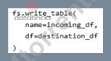
They have been informed that they now require these features to be available in "real-time", with latency on the order of a minute. Their manager has informed them there is now a Kafka stream from which they can stream live data, and they need to have this ingested and available for low- latency feature lookups.
Which change to their existing code will achieve this?
- A. Create a custom pyfunc MLflow model which processes results of the Kafka stream for on demand feature calculation.
- B. Change the incoming_df to be a dataframe based on a readStream() from the kafka source, the write_table() method will provide a low-latency lookup on this data.
- C. Run a triggered workflow to ingest the Kafka data to a dataframe that they can use with their existing write_table() command.
- D. Change the incoming_df to be a dataframe based on a readStream() from the Kafka source and publish the table as an online table with the streaming option set to True.
Answer: D
Explanation:
To achieve real-time availability with minute-level latency, the feature data must be continuously ingested from Kafka and published to an online table. Using a streaming DataFrame created with readStream from the Kafka source and enabling the online table with streaming allows incremental updates to be synchronized to the online store, supporting low-latency feature lookups for real-time inference.
NEW QUESTION # 84
A machine learning engineer has deployed a model recommender using MLflow Model Serving.
They now want to query the version of that model that is in the Production stage of the MLflow Model Registry. Which of the following model URIs can be used to query the described model version?
- A. https://<databricks-instance>/model-serving/recommender/stage-production/invocations
- B. The version number of the model version in Production is necessary to complete this task.
- C. https://<databricks-instance>/model-serving/recommender/Production/invocations
- D. https://<databricks-instance>/model/recommender/Production/invocations
- E. https://<databricks-instance>/model/recommender/stage-production/invocations
Answer: B
NEW QUESTION # 85
......
Databricks Databricks-Machine-Learning-Professional Exam Syllabus Topics:
| Topic | Details |
|---|---|
| Topic 1 |
|
| Topic 2 |
|
| Topic 3 |
|
| Topic 4 |
|
| Topic 5 |
|
| Topic 6 |
|
| Topic 7 |
|
| Topic 8 |
|
Get Instant Access to Databricks-Machine-Learning-Professional Practice Exam Questions: https://realpdf.free4torrent.com/Databricks-Machine-Learning-Professional-valid-dumps-torrent.html