

Verified NAS-C01 dumps Q&As - Pass Guarantee Exam Dumps Test Engine [2026]
NAS-C01 dumps and 378 unique questions
NEW QUESTION # 26
A Snowflake Native App is designed to process data in a consumer's account. The application requires access to multiple shared databases provided by different providers. The application provider configures their application. Snowflake is configured so that the app can see all of these shared databases. Now, to enable the Native App with the privileges it requires, what are the necessary steps to allow the application's role, , to query tables in these shared databases?
- A. Only grant 'IMPORTED PRIVILEGES on each shared database to the 'app_role' .
- B. Grant 'ALL PRIVILEGES on each shared database to the 'app_role'. This will allow the application to access all objects within the shared databases.
- C. Grant 'IMPORTED PRIVILEGES' on each shared database to the 'app_role' . Additionally, grant 'SELECT privilege on each specific table or view the application needs to access in each shared database to the 'app_role' .
- D. Grant USAGE on each shared database to the 'app_role' . Additionally, grant 'SELECT privilege on each specific table or view the application needs to access in each shared database to the 'app_role' .
- E. No additional steps are required. Once the application is installed, it automatically has access to all shared databases.
Answer: C
Explanation:
The correct answer is B. While 'IMPORTED PRIVILEGES allows the application to see the shared database, it doesn't automatically grant access to the data within. You must also grant the specific 'SELECT privilege on the tables and views that the application requires. A is incomplete since it is needed, but not sufficient. C is incorrect as USAGE does not provide SELECT ability. D violates the least privilege principle, and E is incorrect because privileges must be explicitly granted.
NEW QUESTION # 27
You are developing a Snowflake Native Application and want to implement robust observability and telemetry. Which of the following approaches will enable you to effectively monitor the application's performance, identify errors, and collect usage metrics within the consumer's account?
- A. The consumer is responsible for implementing observability and telemetry. The application developer cannot implement observability features that function within the consumer's account.
- B. Directly access the consumer's system tables (e.g., 'SNOWFLAKE.ACCOUNT USAGE.QUERY HISTORY) to extract application-related metrics based on query identifiers generated by the application.
- C. Implement custom logging using 'SYSTEM$LOG' and store application logs in a separate table within the application's container. Configure grants to allow the application developer to access these logs.
- D. Rely solely on Snowflake's built-in query history and resource monitoring features in the consumer's account, as these automatically capture all application activity.
- E. Utilize to write log data to a secure table within the application and leverage views granted to the consumer to expose relevant metrics and error information. Ensure appropriate roles have access to the views.
Answer: E
Explanation:
Option C is the most effective approach. Using 'SYSTEM$LOG' allows for structured logging within the application. Storing the logs in a secure table within the application container keeps the data isolated and controlled. Creating views and granting access to specific roles on the consumer side allows the application to expose relevant metrics and error information without granting direct access to the underlying log data. Options A, D, and E are incorrect because they do not provide a comprehensive and controlled observability solution managed by the application developer. Option B is incorrect because the application developer cannot directly access data created in the consumer's account after installation.
NEW QUESTION # 28
You are developing a Snowflake Native Application that allows customers to enrich their dat a. The application involves executing Javascript UDFs. Which of the following practices are considered unacceptable regarding code practices within the UDFs to ensure the Native App complies with Snowflake's requirements and security best practices?
- A. Relying solely on the consumer's network policy to manage external network access from the UDFs.
- B. Using JavaScript's eval() function to dynamically execute code based on user input or data retrieved from external sources.
- C. Directly embedding secrets (e.g., API keys, passwords) within the Javascript UDF code itself, even if obfuscated.
- D. Using the SYSTEM$ALLOWLIST function to restrict external network access from the Javascript UDFs to a specific set of approved domains. Using Snowflake's network rules is also acceptable for newer accounts.
- E. Using Javascript UDFs to access data not needed by the application to save on querying costs.
Answer: A,B,C,E
Explanation:
Options B, C, D and E are all unacceptable. Embedding secrets (B) directly in code is a major security risk. Using 'eval()' (C) opens the door to code injection vulnerabilities. Relying solely on the consumer's network policy (D) is insufficient; the application provider must also implement security measures. Javascript UDFs should only access required data by the application as this is also one of best practices regarding code practices within the UDFs. Option A is acceptable as it implements whitelisting of external network access.
NEW QUESTION # 29
You are tasked with designing a Snowflake Native App that requires multiple roles with different levels of access to its functionalities. The app needs to define which roles can perform specific actions, such as viewing data, modifying data, or managing app settings. Which of the following methods are CORRECT ways to control role-based access within a Snowflake Native App? (Select all that apply)
- A. Creating separate versions of the application for each role, with each version containing only the functionalities that the role is allowed to access.
- B. Using the 'allowed_roleS section in the manifest file to restrict access to certain functionalities based on the consumer's roles. This ensures that only authorized roles can interact with those components.
- C. Defining application roles within the provider account and mapping them to consumer roles during the installation process. These application roles can then be used for fine-grained access control.
- D. Granting specific privileges to roles directly within the application's stored procedures and functions, checking the current role using and conditionally executing code based on the role.
- E. Defining roles within the setup script with specific privileges and instructing the consumer to grant their existing roles to these newly created roles.
Answer: C,D
Explanation:
Option A is correct because using within stored procedures and functions allows you to conditionally execute code based on the current role, providing fine-grained access control. Option D is also correct because defining application roles within the provider account and mapping them to consumer roles during installation allows for a structured and manageable approach to role-based access control within the app.
NEW QUESTION # 30
A Snowflake Native App provider has implemented an Event Table to capture application logs. They observe a significant performance degradation in their application queries when the Event Table grows beyond a certain size. Which of the following strategies can be implemented to mitigate the performance issue, assuming that frequent querying of the last 7 days of data is common? Select ONLY ONE answer.
- A. Increase the warehouse size used for querying the Event Table.
- B. Implement a stored procedure that manually copies the last 7 days of data to a separate, smaller table.
- C. Partition the Event Table by date, using the ' INSTALLATION_TIMESTAMP' column.
- D. Disable automatic clustering on the Event Table.
- E. Create a materialized view on top of the Event Table that filters for events within the last 7 days.
Answer: E
Explanation:
Option B, creating a materialized view that filters for the last 7 days of data, is the MOST effective solution. Materialized views pre- compute and store the results of the query, so subsequent queries against the view are significantly faster. Increasing the warehouse size (Option A) might provide some improvement but does not address the fundamental issue of scanning the entire table. Partitioning (Option C) is not supported in Snowflake. Implementing a stored procedure (Option D) adds complexity and overhead. Disabling automatic clustering (Option E) will degrade performance.
NEW QUESTION # 31
A Snowflake Native Application developer is troubleshooting an issue where application installations are failing intermittently in consumer accounts. The application relies on a specific version of a Python library. What is the MOST likely cause of this issue, and what steps can the developer take to resolve it within the Snowflake Native App framework?
- A. The application's code contains a bug that only manifests in specific Snowflake regions. The developer should add region-specific exception handling.
- B. The application is trying to access a private endpoint not accessible to the consumer. The consumer should setup a network rule for this endpoint.
- C. The consumer's Snowflake environment lacks sufficient compute resources. Increase the warehouse size on the consumer's account.
- D. The required Python library version is not available in the consumer's Snowflake environment. The developer should bundle the specific version of the Python library with the application package, leveraging the manifest file.
- E. A firewall rule on the consumer's network is blocking access to the application. The consumer needs to whitelist the application's IP address.
Answer: D
Explanation:
The most likely cause is a missing or incompatible Python library version in the consumer's environment. Snowflake Native Applications allow developers to bundle specific library versions with the application using the manifest file. This ensures consistent behavior across different consumer environments, resolving dependency conflicts and installation failures.
NEW QUESTION # 32
A Snowflake Native Application developer wants to ensure that a specific stored procedure, 'UPDATE CUSTOMER STATUS, within their application can only be executed by users who have been granted the 'CUSTOMER ADMIN' role in the consumer's account. How can the developer enforce this authorization check within the stored procedure's code?
- A. Implement a custom function that calls 'SYSTEM$GET PRIVILEGES()' and checks if the user executing the stored procedure possesses the 'CUSTOMER ADMIN' role.
- B. Grant the 'EXECUTE privilege on the stored procedure only to the 'CUSTOMER_ADMIN' role in the consumer's account.
- C. Use the 'CURRENT ROLE()' function within the stored procedure to check if the current role is 'CUSTOMER ADMIN'. If not, raise an error.
- D. Utilize the 'SESSION CONTEXT()' function to check for a specific context variable set only when a user with the 'CUSTOMER ADMIN' role is connected.
- E. Use the function within the stored procedure to verify that the 'CUSTOMER_ADMIN' role is currently active in the session. If not, raise an error.
Answer: E
Explanation:
Option E is the correct approach. directly checks if the specified role is active in the current session, providing a reliable way to enforce role-based access control within the stored procedure. Option A will not work as returns the primary role, not all active roles. Option B controls who can be granted the ability to execute the procedure, but not who is executing it at runtime. Option C is overly complex and less efficient. Option D relies on external context variables, making the authorization less self-contained and harder to manage.
NEW QUESTION # 33
You are developing a Snowflake Native Application that needs to be deployed across multiple consumer accounts. The application relies on a secure external function (SEF) for real-time data enrichment. The SEF interacts with a third-party API secured with OAuth 2.0. What are the MOST important considerations when designing the setup script for this application to ensure seamless deployment and security in the consumer accounts?
- A. The setup script should pre-configure the API integration in the provider account and securely share the credentials with consumer accounts during the installation process.
- B. The setup script should attempt to automatically create the API integration using the provider's credentials, but gracefully handle failures if the consumer's account lacks necessary privileges.
- C. The setup script should explicitly create a new API integration with the consumer's credentials, separate from the provider's account. Consumer will manually update credentials.
- D. The setup script should include instructions for the consumer to manually create and configure the API integration using their own OAuth 2.0 credentials after the application is installed.
- E. The setup script should create an API integration referencing a secret object in the consumer account, allowing the consumer to inject their own credentials post- installation.
Answer: D,E
Explanation:
Options C and E are the most secure and practical. Option C gives the consumer full control of the OAuth credentials. Option E uses secure secret objects, providing a way for consumers to inject their credentials post-installation without exposing them directly in the setup script, adhering to the principle of least privilege and enhancing security. Options A and B represent poor security practice. Option D is unreliable.
NEW QUESTION # 34
You are developing a Snowflake Native App that requires specific Snowflake features and functionalities. To ensure compatibility and proper execution across different consumer environments, you need to define the minimum required Snowflake version. Which section in the manifest file is used to specify the minimum Snowflake version required by the application and what is the correct syntax?
- A. The 'configuration' section. Syntax: '"configuration": {"required_snowflake_version": "7.0"}'
- B. The 'dependencies' section. Syntax: '"dependencies": [{"snowflake_version":">=7.0"}]
- C. The 'api_version' section. Syntax: '"api_version": along with in the 'applications section.
- D. The 'setup' section. Syntax:
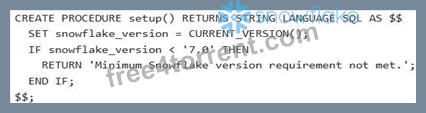
- E. The 'application' section. Syntax: '"application": {"min_snowflake_version": "7.0"}'
Answer: E
Explanation:
The 'application' section within manifest file is used to specify minimum snowflake version required by Snowflake Native Application with the syntax '"application": {"min_snowflake_version": "7.0"}'. This attribute ensures that app installed is compatible with consumer account.
NEW QUESTION # 35
You're developing a Snowflake Native App that includes a function, , which retrieves sensitive customer dat a. You want to ensure that this data is only accessible by authorized roles within the consumer's account, even after the application is installed. Which of the following strategies are appropriate for securing the application's data and function access? (Choose two)
- A. Grant the 'EXECUTE privilege on the function to the 'application role'.
- B. Implement a masking policy on the underlying customer data table that restricts access based on the current role.
- C. Rely solely on the consumer's account administrator to manage access to the function and data after installation.
- D. Grant the 'EXECUTE privilege on the function to specific, consumer-defined roles within the consumer's account via the provider's setup script.
- E. Use a secure UDF to encapsulate the data retrieval logic, preventing direct access to the underlying tables.
Answer: B,D
Explanation:
Implementing a masking policy (Option A) directly on the underlying data table ensures that data is masked or restricted based on the user's role, regardless of how the data is accessed. Granting 'EXECUTE to consumer-defined roles (Option C) allows the provider to explicitly control which roles in the consumer's account have access to the function. Option B is incorrect as giving Execute permission to application role won't restrict access within consumer account. Option D can enhance security, it requires role base access control to be truly useful as the UDF will still need explicit role definitions of user access. Option E is insufficient; the provider needs to actively participate in securing the data through mechanisms like masking policies and role-based access control via grants in the setup script.
NEW QUESTION # 36
You are developing a Snowflake Native Application that requires access to an external API to enrich data within the consumer's account. You need to implement secure authentication and authorization to this external API. Which of the following methods provide the MOST secure and compliant approach for storing and managing the API credentials within your Snowflake Native Application package, while minimizing the risk of exposure to the consumer?
- A. Prompt the consumer to provide the API credentials during the application installation process, storing them in a secure configuration table within their account and referencing them from your application through secure views.
- B. Store the API credentials as a secret within Snowflake's Secret Management feature, referencing the secret from within your application's functions. Grant access to the secret through the application role.
- C. Store the API credentials as environment variables within the Snowflake function code that calls the API. These variables are automatically encrypted by Snowflake.
- D. Store the API credentials in a secure configuration table within your application package, encrypted using a symmetric key managed by Snowflake's KMS.
- E. Store the API credentials as plain text within the setup script, as this script is only executed once during installation and is not accessible to consumers.
Answer: B
Explanation:
Using Snowflake's Secret Management is the recommended approach for securely storing and managing sensitive credentials. Storing the credentials as a secret and granting access via application role ensures that only authorized code within the application can access the credentials. Storing as plain text is a major security risk. Environment variables (while encrypted) aren't best practice for long-term credential storage. Prompting the consumer relies on them to securely manage the credentials.
NEW QUESTION # 37
Consider a scenario where a Snowflake Native Application contains a task named "daily data sync'. This task needs to be executed in the consumer's account. To enable proper monitoring and governance within the consumer's account, the consumer wants to tag the executions of this task. Which of the following actions must the application provider take to ensure that the consumer can successfully tag the 'daily data sync' task executions without compromising the security of the application or requiring the consumer to have elevated privileges on the application database?
- A. The provider must grant the APPLY MASKING POLICY privilege on the task to the consumer's account role, enabling the consumer to configure tags via masking policies.
- B. The provider cannot enable the consumer to tag the task executions without granting elevated privileges on the application database or compromising security; tagging is solely the provider's responsibility.
- C. The provider must grant the OWNERSHIP privilege on the task to the consumer's account role, allowing the consumer to set tags directly.
- D. The provider must grant the APPLY TAG privilege on the account to the consumer s account role.
- E. The provider must grant the APPLY TAG privilege on the task to the consumer's account role. No other configuration is necessary.
Answer: D
Explanation:
Granting the 'APPLY TAG' privilege on the account to the consumer s account role enables the consumer to tag objects (including task executions) within their own account. This approach avoids granting elevated privileges on the application database or compromising the application's security, as the consumer is only able to apply tags and not modify the underlying task definition or data. The 'APPLY MASKING POLICY privilege is irrelevant for tagging, and 'OWNERSHIP' is too broad, potentially compromising security. Providers can create tasks with appropriate roles and grants to permit tagging for consumers.
NEW QUESTION # 38
Consider the following snippet from a Snowflake Native App manifest file (application.yaml):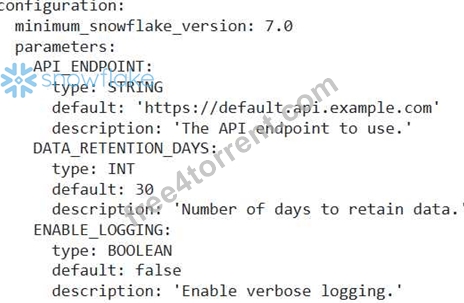
Which of the following statements are TRUE regarding how these parameters can be accessed and used within the application's SQL code?
- A. Option B
- B. Option A
- C. Option C
- D. Option D
- E. Option E
Answer: A,C
Explanation:
Snowflake Native Apps use 'SYSTEM$GET PARAMETER to access parameter values defined in the manifest. This function retrieves the current value of the parameter, which can be either the default value defined in the manifest or a value overridden by the app package consumer during installation. Thus C is also correct. Direct variable access (A) is incorrect and Parameters are not restricted only to manifest file. They are accessible at runtime. So D and E are also incorrect
NEW QUESTION # 39
A Native App provider wants to use a parameter in their MANIFEST.yml to dynamically control the number of worker threads a stored procedure uses. The desired behavior is to allow the consumer to configure this value. Considering security best practices, which of the following parameter definitions in the 'MANIFEST.yml' is the MOST appropriate?
- A.

- B.

- C.

- D.

- E.

Answer: E
Explanation:
Option E is the MOST appropriate. While 'secure: true' is important to encrypt and protect the parameter value, 'validation_rules' provide an extra layer of security and data integrity by ensuring the consumer provides a valid value within a defined range. It prevents potentially harmful or unexpected values from being used, enhancing the app's robustness. Type INT also correctly defines the expected data type.
NEW QUESTION # 40
A data science team within your organization is developing a Snowflake Native App that needs to access and process customer data stored in a Snowflake database. The app must only access data for customers residing in the 'USA' region. The team has created a custom role 'APP ROLE for the app to use. Which of the following is the MOST secure and efficient way to grant the app the necessary permissions to read the filtered data? Assume a secure view approach is preferred over direct table access.
- A. Create a secure view that filters customer data to include only customers in the 'USA' region and grant the SAPP ROLE the 'SELECT privilege on the secure view.
- B. Grant the SAPP ROLE the 'OWNERSHIP' privilege on the base customer data table and implement data filtering logic within the app itself.
- C. Grant the 'APP_ROLE the 'USAGE privilege on the database and schema containing the customer data table. Data filtering should still be handled by the app.
- D. Create a standard view (non-secure) that filters customer data to include only customers in the 'USA' region and grant the 'APP_ROLE the 'SELECT' privilege on this view.
- E. Grant the 'APP_ROLE the 'SELECT privilege on the base customer data table and rely on row-level security policies defined on that table.
Answer: A
Explanation:
Secure views offer a crucial security advantage: they hide the underlying table structure and any associated metadata from the app, only exposing the filtered data. Row-level security (RLS) can work (A), but secure views provide an extra layer of abstraction and security, hiding the existence of other rows. Granting ownership (C) is highly insecure and unnecessary. Non-secure views (D) do not offer the security benefits required for sensitive data. USAGE privilege alone (E) doesn't grant any data access without SELECT.
NEW QUESTION # 41
You are building a Snowflake Native Application that offers a data enrichment service. You want to automate the fulfillment of new customer trials. When a customer installs your application from the Marketplace, you want to automatically provision them with a limited dataset and compute resources for a 30-day trial period. Which of the following Snowflake features and implementation steps are essential for achieving this auto-fulfillment strategy? (Choose two)
- A. Implement a webhook endpoint within your Native Application that listens for installation events from the Snowflake Marketplace and triggers the provisioning process.
- B. Utilize Snowflake's External Functions to call an external auto-fulfillment service (e.g., AWS Lambda) that handles the provisioning logic.
- C. Employ Snowflake's Event Tables to capture installation events and trigger a stored procedure within the Native App to provision the trial environment.
- D. Use Snowflake's Resource Monitors to automatically limit the credit usage for each trial customer account.
- E. Leverage Snowflake's Marketplace Auto-Fulfillment API to automatically create a dedicated share for each customer, granting them access to the limited dataset.
Answer: C,D
Explanation:
Event Tables is the correct method for automatically trigger a stored procedure within the Native App to provision the trial environment. Resource Monitors is correct because Resource monitors in Snowflake allow you to control credit usage. Once the number of credits a Snowflake virtual warehouse (or the entire account) uses reaches a defined threshold, triggers can either send notifications or suspend the warehouse.
NEW QUESTION # 42
A Snowflake Native App developer wants to utilize a README.md file within their application package. Which of the following statements accurately describe the supported usage and purpose of the README.md file in this context?
- A. The README.md file must adhere to a specific Snowflake schema for metadata to be automatically extracted and displayed within the consumer's Snowflake environment post-installation.
- B. The README.md file is a Markdown formatted file and used only for internal documentation by the app developer and is not exposed to consumers through any Snowflake interface.
- C. The README.md file is automatically displayed to consumers within the Snowflake Marketplace listing, providing a detailed overview of the app's functionality and installation instructions.
- D. The README.md file can be programmatically accessed within the application logic using a Snowflake-provided API to dynamically generate documentation for the consumer.
- E. Snowflake automatically renders the READMmd file as part of the application s user interface within the consumer s account, allowing them to view documentation directly from Snowflake.
Answer: C
Explanation:
The README.md file in a Snowflake Native App package is primarily used to populate the app's listing in the Snowflake Marketplace. It provides information about the app to potential consumers. It's not used for internal documentation only, nor is it rendered within the consumer's account post-installation. It doesn't require a specific Snowflake schema, nor is it programmatically accessible from the app.
NEW QUESTION # 43
You are developing a Snowflake Native App that requires accessing a specific table within the consumer's account. The consumer should not have direct access to this table. Which of the following is the MOST secure and appropriate method to grant the necessary access?
- A. Granting the CONSUMPTION usage privilege on the provider account database to the consumer account, and then granting SELECT on the specific table to a role that the app assumes.
- B. Creating a Snowflake Secure UDF that queries the table within the provider account and exposing the UDF to the consumer account through a package.
- C. Granting direct SELECT access to the consumer role on the table in the provider account, ensuring to revoke access after the app is installed.
- D. Creating a Snowflake Secure View on the table in the provider account and sharing this view with the consumer account using Data Sharing.
- E. Employing a Stored Procedure owned by the application role that queries the table in the provider account, and allowing access to the procedure via API integration.
Answer: B
Explanation:
Secure UDFs allow you to execute queries in the provider account without exposing the underlying table directly to the consumer. This isolates the data and minimizes the risk of unauthorized access. Stored procedures offer similar functionality, but UDFs are generally simpler and more performant for basic data retrieval. Secure Views via data sharing expose the structure to the consumer account, and granting direct access is a major security risk.
NEW QUESTION # 44
A Snowflake Native App provider is using a Snowpark Python UDF to process data before writing it to an event table for consumption by consumer applications. The UDF fails intermittently with a 'Java heap space' error. Which of the following strategies are MOST effective in mitigating this error?
- A. Optimize the Python UDF code to use more memory-efficient data structures and algorithms, reducing overall memory consumption.
- B. Implement batch processing within the UDF to process data in smaller chunks, reducing the memory footprint at any given time.
- C. Increase the warehouse size used by the consumer application instance, as this controls the memory available to the UDF during event processing.
- D. Switch to a Java UDF instead of a Python UDF, as Java UDFs inherently have better memory management in Snowflake.
- E. Configure the event table function to use a larger warehouse size using the EXECUTE AS OWNER clause.
Answer: A,B
Explanation:
B and D are correct. B: Batch processing avoids loading the entire dataset into memory at once. D: Optimizing the code to be memory-efficient directly addresses the root cause. A is incorrect as warehouse size for the consumer application is not the controling factor for UDF event processing. C is incorrect because the warehouse size of the provider application instance controls UDF size, not consumer warehouse size. E is incorrect because switching the UDF language doesn't fundamentally solve the memory problem if the underlying code is still inefficient.
NEW QUESTION # 45
A Snowflake Native App includes a managed task 'app_db.app_schema.daily_data_processing'. You, as the application provider, need to ensure that consumer accounts can only execute this managed task and have no other privileges. You also need to implement robust error handling to log any failed execution attempts within the consumer account. Which of the following SQL statements, when executed within the application's installation script, provides the most secure and complete solution to achieve these requirements, including error logging within the consumer account (assuming an existing table exists)?
- A. GRANT EXECUTE MANAGED TASK ON MANAGED TASK TO APPLICATION ROLE app_public;
- B.

- C.

- D. GRANT EXECUTE MANAGED TASK ON MANAGED TASK TO APPLICATION ROLE app_public WITH GRANT OPTION;
- E.

Answer: C
Explanation:
Option C is the most comprehensive. It grants the necessary USAGE privileges on the database and schema, which are prerequisites for the consumer account's application role to access the managed task. It also includes robust error handling using a BEGIN...EXCEPTION block, logging any errors encountered during the privilege granting process to the 'execution_log' table. Options A and D are missing the necessary USAGE privileges, which would prevent the task from executing. Option B lacks USAGE grants and only handles errors within the GRANT execution itself, not potential issues with missing database/schema access for the role. Option E includes 'WITH GRANT OPTION' , which is unnecessary and potentially insecure as it allows the consumer to further grant the EXECUTE MANAGED TASK privilege.
NEW QUESTION # 46
A Native App developer is using Snowflake's Event Tables for tracing the execution of their application. They have noticed a significant performance overhead when event logging is enabled, particularly for high-volume UDFs. Which of the following strategies would be MOST effective in mitigating the performance impact of event logging while still capturing valuable tracing information?
- A. Increase the frequency of event table flushes to reduce the number of events buffered in memory. This minimizes memory pressure and write latency.
- B. Implement sampling or conditional logging within the UDFs, only logging events for a subset of executions or when specific conditions are met. Utilize asynchronous logging techniques where appropriate to offload logging operations.
- C. Write event data directly to an external cloud storage system (e.g., AWS S3, Azure Blob Storage) bypassing Snowflake's Event Tables altogether.
- D. Disable event logging entirely for high-volume UDFs to eliminate the performance overhead.
- E. Reduce the number of columns captured in the event tables to minimize the amount of data being written. Store all tracing data in a single large event table to simplify querying.
Answer: B
Explanation:
Option C offers the best balance between performance and valuable tracing information. Sampling allows you to reduce the volume of events logged, while conditional logging ensures that only relevant events are captured. Asynchronous logging further minimizes the performance impact. Option A is not desirable as it eliminates tracing altogether. Option B will not reduce overhead. Option D is a good strategy but doesn't address high logging volumes. Option E may not be compliant or possible.
NEW QUESTION # 47
A Snowflake Native App provider is working on the consumer-side testing of their application. They need to verify that specific events are being recorded correctly in the Event Table within the consumer's account. They are using the Snowflake Native Apps framework's testing capabilities. Which of the following approaches would be MOST reliable for validating the contents of the Event Table during automated testing?
- A. Use the 'SHOW EXTERNAL TABLES command within the consumer account to inspect the Event Table's structure and contents.
- B. Grant SELECT privileges on the Event Table to a role in the consumer account that is accessible by the provider's testing framework.
- C. Directly query the Event Table from the provider's account using a cross-account secure data share.
- D. Utilize the testing framework's built-in assertion capabilities to verify that specific events are present in the Event Table based on expected values.
- E. Implement a stored procedure within the Native App that queries the Event Table and returns the results to the provider through a secure output parameter.
Answer: D
Explanation:
Option D, utilizing the testing framework's built-in assertion capabilities, is the MOST reliable and secure approach. The Snowflake Native Apps framework provides dedicated mechanisms for testing and validating application behavior within the consumer's environment, including verifying the contents of Event Tables. Direct access from the provider's account (Option A) is generally not permitted or recommended for security reasons. 'SHOW EXTERNAL TABLES' (Option B) won't work for internal tables created by the Native App. While a stored procedure (Option C) could work, it's less secure and more complex than using the built-in testing framework. Granting SELECT privileges (Option E) poses a security risk and is generally discouraged.
NEW QUESTION # 48
......
NAS-C01 Dumps for Pass Guaranteed - Pass NAS-C01 Exam: https://realpdf.free4torrent.com/NAS-C01-valid-dumps-torrent.html