

DP-420 Exam Questions Dumps, Selling Microsoft Products
DP-420 Cert Guide PDF 100% Cover Real Exam Questions
Microsoft DP-420 exam is an industry-recognized certification designed for professionals who want to prove their expertise in designing and implementing cloud-native applications using Microsoft Azure Cosmos DB. This is an advanced-level exam that tests the candidate's knowledge and skills in cloud-native application development, Azure Cosmos DB, and other related technologies.
Skills measured
- Integrate an Azure Cosmos DB solution (5–10%)
- Design and implement data models (35–40%)
- Maintain an Azure Cosmos DB solution (25–30%)
- Design and implement data distribution (5–10%)
- Optimize an Azure Cosmos DB solution (15–20%)
NEW QUESTION # 26
You have a container named container1 in an Azure Cosmos DB Core (SQL) API account. The container1 container has 120 GB of data.
The following is a sample of a document in container1.
The orderId property is used as the partition key.
For each of the following statements, select Yes if the statement is true. Otherwise, select No.
NOTE: Each correct selection is worth one point.
Answer:
Explanation: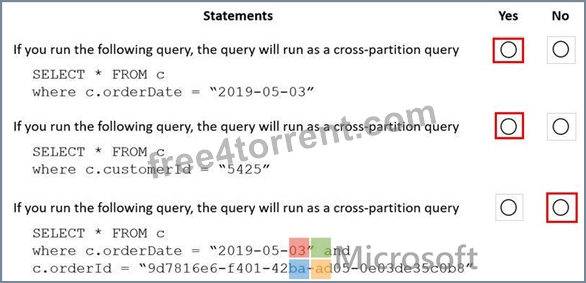
NEW QUESTION # 27
The following is a sample of a document in orders.
The orders container uses customerId as the partition key.
You need to provide a report of the total items ordered per month by item type. The solution must meet the following requirements:
Ensure that the report can run as quickly as possible.
Minimize the consumption of request units (RUs).
What should you do?
- A. Configure the report to query orders by using a SQL query.
- B. Configure the report to query orders by using a SQL query through a dedicated gateway.
- C. Configure the report to query a new aggregate container. Populate the aggregates by using the change feed.
- D. Configure the report to query a new aggregate container. Populate the aggregates by using SQL queries that run daily.
Answer: C
Explanation:
You can facilitate aggregate data by using Change Feed and Azure Functions, and then use it for reporting.
NEW QUESTION # 28
You have an Azure Cosmos DB for NoSQL account that has multiple write regions.
You need to receive an alert when requests that target the database exceed the available request units per second (RU/s).
Which Azure Monitor signal should you use?
- A. Metadata Requests
- B. Document Quota
- C. Region Removed
- D. Data Usage
Answer: B
Explanation:
Explanation
Azure Monitor is a service that provides comprehensive monitoring for Azure resources, including Azure Cosmos DB. You can use Azure Monitor to collect, analyze, and alert on metrics and logs from your Azure Cosmos DB account. You can create alerts for Azure Cosmos DB using Azure Monitor based on the metrics, activity log events, or Log Analytics logs on your account1.
For your scenario, if you want to receive an alert when requests that target the database exceed the available request units per second (RU/s), you should use the Document Quota metric. This metric measures the percentage of RU/s consumed by your account or container. You can create an alert rule on this metric from the Azure portal by following these steps2:
* In the Azure portal, select the Azure Cosmos DB account you want to monitor.
* Under the Monitoring section of the sidebar, select Alerts, and then select New alert rule.
* In the Create alert rule pane, fill out the Scope section by selecting your subscription name and resource type (Azure Cosmos DB accounts).
* In the Condition section, select Add condition and choose Document Quota from the list of signals.
* In the Configure signal logic pane, specify the threshold value and operator for your alert condition. For example, you can choose Greater than or equal to 90 as the threshold value and operator to receive an alert when your RU/s consumption reaches 90% or more of your provisioned throughput.
* In the Alert rule details section, specify a name and description for your alert rule.
* In the Actions section, select Add action group and choose how you want to receive notifications for your alert. For example, you can choose Email/SMS/Push/Voice as an action type and enter your email address or phone number as a receiver.
* Review your alert rule settings and select Create alert rule to save it.
NEW QUESTION # 29
You plan to implement con-iot1 and con-iot2.
You need to configure the default Time to Live setting for each container. The solution must meet the loT telemetry requirements.
What should you configure? To answer, select the appropriate options in the answer NOTE: Each correct selection is worth one point.
Answer:
Explanation:
NEW QUESTION # 30
You have an Azure Cosmos DB account named account1.
You have several apps that connect to account1 by using the account's secondary key.
You then configure the apps to authenticate by using service principals.
You need to ensure that account1 will only allow apps to connect by using an Azure AD identity.
Which account property should you modify?
- A. allowedOrxgins
- B. disableKeyBasedMetadataWriteAccess ,
- C. userAssignedldentatxe
- D. disableLocalAuth
Answer: D
Explanation:
Explanation
The disableLocalAuth property is a boolean flag that indicates whether local authentication methods such as primary/secondary keys are disabled for the Azure Cosmos DB account. Setting this property to true improves security by ensuring that Azure Cosmos DB accounts exclusively require Azure Active Directory identities for authentication1.
NEW QUESTION # 31
Note: This question is part of a series of questions that present the same scenario. Each question in the series contains a unique solution that might meet the stated goals. Some question sets might have more than one correct solution, while others might not have a correct solution.
After you answer a question in this section, you will NOT be able to return to it. As a result, these questions will not appear in the review screen.
You have a container named container1 in an Azure Cosmos DB Core (SQL) API account.
You need to make the contents of container1 available as reference data for an Azure Stream Analytics job.
Solution: You create an Azure Data Factory pipeline that uses Azure Cosmos DB Core (SQL) API as the input and Azure Blob Storage as the output.
Does this meet the goal?
- A. No
- B. Yes
Answer: A
NEW QUESTION # 32
You have an Azure Cosmos DB Core (SQL) API account used by an application named App1.
You open the Insights pane for the account and see the following chart.
Use the drop-down menus to select the answer choice that answers each question based on the information presented in the graphic.
NOTE: Each correct selection is worth one point.
Answer:
Explanation:
Explanation:
Box 1: incorrect connection URLs
400 Bad Request: Returned when there is an error in the request URI, headers, or body. The response body will contain an error message explaining what the specific problem is.
The HyperText Transfer Protocol (HTTP) 400 Bad Request response status code indicates that the server cannot or will not process the request due to something that is perceived to be a client error (for example, malformed request syntax, invalid request message framing, or deceptive request routing).
Box 2: 6 thousand
201 Created: Success on PUT or POST. Object created or updated successfully.
Note:
200 OK: Success on GET, PUT, or POST. Returned for a successful response.
404 Not Found: Returned when a resource does not exist on the server. If you are managing or querying an index, check the syntax and verify the index name is specified correctly.
Reference: https://docs.microsoft.com/en-us/rest/api/searchservice/http-status-codes
NEW QUESTION # 33
You have an on-premises network.
You have an Azure subscription that contains an Azure Cosmos DB account named account1 and an Azure virtual network named VNet1. VNet1 contains two virtual machines named VM1 and VM2. VNet1 is connected to the on-premises network by using a Site-to-Site (S2S) VPN.
You need to meet the following requirements:
* Block access to the public endpoint of account1.
* Allow only VM1 to access account1.
What should you include in the solution? To answer, select the appropriate options in the answer area.
NOTE: Each correct selection is worth one point.
Answer:
Explanation:
Explanation:
NEW QUESTION # 34
You need to select the capacity mode and scale configuration for account2 to support the planned changes and meet the business requirements. What should you select? To answer, select the appropriate options in the answer area. NOTE: Each correct selection is worth one point.
Answer:
Explanation:
Explanation
NEW QUESTION # 35
You plan to create an Azure Cosmos DB database named db1 that will contain two containers. One of the containers will contain blog posts, and the other will contain users. Each item in the blog post container will include:
* A single blog post
* All the comments associated to the blog post
* The names of the users who created the blog post and added the comments.
You need to design a solution to update usernames m the user container without causing data integrity issues.
The solution must minimize administrative and development effort. What should you include in the solution?
To answer, select the appropriate options in the answer area.
NOTE: Each correct selection is worth one point.
Answer:
Explanation:
Explanation:
NEW QUESTION # 36
You have an Azure Cosmos DB Core (SQL) API account named account1 that has the disableKeyBasedMetadataWriteAccess property enabled.
You are developing an app named App1 that will be used by a user named DevUser1 to create containers in account1. DevUser1 has a non-privileged user account in the Azure Active Directory (Azure AD) tenant.
You need to ensure that DevUser1 can use App1 to create containers in account1.
What should you do? To answer, select the appropriate options in the answer area.
NOTE: Each correct selection is worth one point.
Answer:
Explanation:
Reference:
https://docs.microsoft.com/en-us/azure/cosmos-db/secure-access-to-data
https://docs.microsoft.com/en-us/rest/api/resources/
NEW QUESTION # 37
You have a database named db1 in an Azure Cosmos DB for NoSQL
You are designing an application that will use dbl.
In db1, you are creating a new container named coll1 that will store in coll1.
The following is a sample of a document that will be stored in coll1.
The application will have the following characteristics:
* New orders will be created frequently by different customers.
* Customers will often view their past order history.
You need to select the partition key value for coll1 to support the application. The solution must minimize costs.
To what should you set the partition key?
- A. customerId
- B. orderDate
- C. orderId
- D. id
Answer: B
Explanation:
Based on the characteristics of the application and the provided document structure, the most suitable partition key value for coll1 in the given scenario would be the customerId, Option B.
The application frequently creates new orders by different customers and customers often view their past order history. Using customerId as the partition key would ensure that all orders associated with a particular customer are stored in the same partition. This enables efficient querying of past order history for a specific customer and reduces cross-partition queries, resulting in lower costs and improved performance.
a partition key is a JSON property (or path) within your documents that is used by Azure Cosmos DB to distribute data among multiple partitions3. A partition key should have a high cardinality, which means it should have many distinct values, such as hundreds or thousands1. A partition key should also align with the most common query patterns of your application, so that you can efficiently retrieve data by using the partition key value1.
Based on these criteria, one possible partition key that you could use for coll1 is B. customerId.
This partition key has the following advantages:
It has a high cardinality, as each customer will have a unique ID3.
It aligns with the query patterns of the application, as customers will often view their past order history3.
It minimizes costs, as it reduces the number of cross-partition queries and optimizes the storage and throughput utilization1.
This partition key also has some limitations, such as:
It may not be optimal for scenarios where orders need to be queried independently from customers or aggregated by date or other criteria3.
It may result in hot partitions or throttling if some customers create orders more frequently than others or have more data than others1.
It may not support transactions across multiple customers, as transactions are scoped to a single logical partition2.
Depending on your specific use case and requirements, you may need to adjust this partition key or choose a different one. For example, you could use a synthetic partition key that concatenates multiple properties of an item2, or you could use a partition key with a random or pre-calculated suffix to distribute the workload more evenly2.
NEW QUESTION # 38
You have an Azure Cosmos DB Core (SQL) API account named account1 that has the disableKeyBasedMetadataWriteAccess property enabled.
You are developing an app named App1 that will be used by a user named DevUser1 to create containers in account1. DevUser1 has a non-privileged user account in the Azure Active Directory (Azure AD) tenant.
You need to ensure that DevUser1 can use App1 to create containers in account1.
What should you do? To answer, select the appropriate options in the answer area.
NOTE: Each correct selection is worth one point.
Answer:
Explanation:
Explanation
Box 1: Resource tokens
Resource tokens provide access to the application resources within a database. Resource tokens:
Provide access to specific containers, partition keys, documents, attachments, stored procedures, triggers, and UDFs.
Box 2: Azure Resource Manager API
You can use Azure Resource Manager to help deploy and manage your Azure Cosmos DB accounts, databases, and containers.
Reference:
https://docs.microsoft.com/en-us/azure/cosmos-db/secure-access-to-data
https://docs.microsoft.com/en-us/rest/api/resources/
NEW QUESTION # 39
You have an Azure Cosmos DB account named account1 that has a default consistency level of session.
You have an app named App1.
You need to ensure that the read operations of App1 can request either bounded staleness or consistent prefix consistency.
What should you modify for each consistency level? To answer, select the appropriate options in the answer area.
NOTE: Each correct selection is worth one point.
Answer:
Explanation:
Explanation:
Box 1 = The request level options
Azure Cosmos DB offers five well-defined consistency levels: strong, bounded staleness, session, consistent prefix and eventual. You can configure the default consistency level on your Azure Cosmos DB account at any time2. The default consistency level applies to all databases and containers under that account1. You can also override the default consistency level for a specific request by using the request options2.
Box 2 = The request level options
To modify the consistency level of a read operation in Azure Cosmos DB, you can use request-level options to override the account's default consistency setting. Therefore, to ensure that the read operations of App1 can request either consistent prefix or session consistency, you need to modify the request-level options for each operation. Reference: - https://docs.microsoft.com/en-us/azure/cosmos-db/consistency-levels
NEW QUESTION # 40
You have an Azure Cosmos DB for NoSQL account that uses a custom conflict resolution policy. The account has a registered merge procedure that throws a runtime exception. The runtime exception prevents conflicts from being resolved.
You need to use an Azure function to resolve the conflicts. What should you use?
- A. a function that pulls items from the change feed and is triggered by a timer trigger
- B. a function that receives items pushed from the change feed and is triggered by an Azure Cosmos DB trigger
- C. a function that pulls items from the conflicts feed and is triggered by a timer trigger
- D. a function that receives items pushed from the conflicts feed and is triggered by an Azure Cosmos DB trigger
Answer: D
NEW QUESTION # 41
You have a container in an Azure Cosmos DB Core (SQL) API account.
You need to use the Azure Cosmos DB SDK to replace a document by using optimistic concurrency.
What should you include in the code? To answer, select the appropriate options in the answer area.
NOTE: Each correct selection is worth one point.
Answer:
Explanation:
Reference:
https://docs.microsoft.com/en-us/dotnet/api/microsoft.azure.cosmos.itemrequestoptions
https://cosmosdb.github.io/labs/dotnet/labs/10-concurrency-control.html
NEW QUESTION # 42
Note: This question is part of a series of questions that present the same scenario. Each question in the series contains a unique solution that might meet the stated goals. Some question sets might have more than one correct solution, while others might not have a correct solution.
After you answer a question in this section, you will NOT be able to return to it. As a result, these questions will not appear in the review screen.
You have an Azure Cosmos DB Core (SQL) API account named account 1 that uses autoscale throughput.
You need to run an Azure function when the normalized request units per second for a container in account1 exceeds a specific value.
Solution: You configure the function to have an Azure CosmosDB trigger.
Does this meet the goal?
- A. No
- B. Yes
Answer: A
Explanation:
Explanation
Instead configure an Azure Monitor alert to trigger the function.
You can set up alerts from the Azure Cosmos DB pane or the Azure Monitor service in the Azure portal.
Reference: https://docs.microsoft.com/en-us/azure/cosmos-db/create-alerts
NEW QUESTION # 43
You are developing an application that will connect to an Azure Cosmos DB for NoSQL account. The account has a single readme region and one agonal read region. The regions are configured for automatic failover.
The account has the following connect strings. (Line numbers are included for reference only.)
For each of the following statements, select Yes if the statement is true. otherwise, select No.
NOTE: Each correct selection is worth one point.
Answer:
Explanation:
Explanation:
If the primary write region fails, applications that write to the database must use a different connection string to continue to use the service. = NOYou do not need to use a different connection string to continue to use the service if the primary write region fails. This is because Azure Cosmos DB supports automatic failover, which means that it will automatically switch the primary write region to another region in case of a regional outage2
. The application does not need to change the connection string or specify the failover priority3. The connection string contains a list of all the regions associated with your account, and Azure Cosmos DB will route the requests to the appropriate region based on the availability and latency1.
The primary Read-Only SQL Connection String and the Secondary Read-Only SQL Connection String will connect to different regions from an application running in the East US Azure region = YesThe primary read-only SQL connection string and the secondary read-only SQL connection string will connect to different regions from an application running in the East US Azure region. This is because the primary read-only SQL connection string contains the endpoint for the East US region, which is the same as the primary write region.
The secondary read-only SQL connection string contains the endpoint for the West US region, which is the additional read region. Therefore, if an application running in the East US Azure region uses these connection strings, it will connect to different regions depending on which one it chooses.
Applications can choose from which region by setting the PreferredLocations property within their connection properties = Yes Applications can choose from which region by setting the PreferredLocations property within their connection properties. This property allows you to specify a list of regions that you prefer to read from based on their proximity to your application2. Azure Cosmos DB will route the requests to the appropriate region based on the availability and latency1. You can also set the ApplicationRegion property to the region where your application is deployed, and Azure Cosmos DB will automatically populate the PreferredLocations property based on the geo-proximity from that location1.
NEW QUESTION # 44
You need to select the partition key for con-iot1. The solution must meet the IoT telemetry requirements.
What should you select?
- A. the temperature
- B. the humidity
- C. the device ID
- D. the timestamp
Answer: C
Explanation:
Explanation
The partition key is what will determine how data is routed in the various partitions by Cosmos DB and needs to make sense in the context of your specific scenario. The IoT Device ID is generally the "natural" partition key for IoT applications.
Scenario: The iotdb database will contain two containers named con-iot1 and con-iot2.
Ensure that Azure Cosmos DB costs for IoT-related processing are predictable.
Reference:
https://docs.microsoft.com/en-us/azure/architecture/solution-ideas/articles/iot-using-cosmos-db
Topic 1, Litware, inc
Case Study
This is a case study. Case studies are not timed separately. You can use as much exam time as you would like to complete each case. However, there may be additional case studies and sections on this exam. You must manage your time to ensure that you are able to complete all questions included on this exam in the time provided.
To answer the questions included in a case study, you will need to reference information that is provided in the case study. Case studies might contain exhibits and other resources that provide more information about the scenario that is described in the case study. Each question is independent of the other questions in this case study.
At the end of this case study, a review screen will appear. This screen allows you to review your answers and to make changes before you move to the next section of the exam. After you begin a new section, you cannot return to this section.
To start the case study
To display the first question in this case study, click the Next button. Use the buttons in the left pane to explore the content of the case study before you answer the questions. Clicking these buttons displays information such as business requirements, existing environment, and problem statements. If the case study has an All Information tab, note that the information displayed is identical to the information displayed on the subsequent tabs. When you are ready to answer a question, click the Question button to return to the question.
Overview
Litware, Inc. is a United States-based grocery retailer. Litware has a main office and a primary datacenter in Seattle. The company has 50 retail stores across the United States and an emerging online presence. Each store connects directly to the internet.
Existing environment. Cloud and Data Service Environments.
Litware has an Azure subscription that contains the resources shown in the following table.
Each container in productdb is configured for manual throughput.
The con-product container stores the company's product catalog data. Each document in con-product includes a con-productvendor value. Most queries targeting the data in con-product are in the following format.
SELECT * FROM con-product p WHERE p.con-productVendor - 'name'
Most queries targeting the data in the con-productVendor container are in the following format SELECT * FROM con-productVendor pv ORDER BY pv.creditRating, pv.yearFounded Existing environment. Current Problems.
Litware identifies the following issues:
Updates to product categories in the con-productVendor container do not propagate automatically to documents in the con-product container.
Application updates in con-product frequently cause HTTP status code 429 "Too many requests". You discover that the 429 status code relates to excessive request unit (RU) consumption during the updates.
Requirements. Planned Changes
Litware plans to implement a new Azure Cosmos DB Core (SQL) API account named account2 that will contain a database named iotdb. The iotdb database will contain two containers named con-iot1 and con-iot2.
Litware plans to make the following changes:
Store the telemetry data in account2.
Configure account1 to support multiple read-write regions.
Implement referential integrity for the con-product container.
Use Azure Functions to send notifications about product updates to different recipients.
Develop an app named App1 that will run from all locations and query the data in account1.
Develop an app named App2 that will run from the retail stores and query the data in account2. App2 must be limited to a single DNS endpoint when accessing account2.
Requirements. Business Requirements
Litware identifies the following business requirements:
Whenever there are multiple solutions for a requirement, select the solution that provides the best performance, as long as there are no additional costs associated.
Ensure that Azure Cosmos DB costs for IoT-related processing are predictable.
Minimize the number of firewall changes in the retail stores.
Requirements. Product Catalog Requirements
Litware identifies the following requirements for the product catalog:
Implement a custom conflict resolution policy for the product catalog data.
Minimize the frequency of errors during updates of the con-product container.
Once multi-region writes are configured, maximize the performance of App1 queries against the data in account1.
Trigger the execution of two Azure functions following every update to any document in the con-product container.
NEW QUESTION # 45
You configure multi-region writes for account1.
You need to ensure that App1 supports the new configuration for account1. The solution must meet the business requirements and the product catalog requirements.
What should you do?
- A. Set the default consistency level of accountl to bounded staleness.
- B. Increase the number of request units per second (RU/s) allocated to the con-product and con-productVendor containers.
- C. Modify the connection policy of App1.
- D. Create a private endpoint connection.
Answer: B
Explanation:
App1 queries the con-product and con-productVendor containers.
Note: Request unit is a performance currency abstracting the system resources such as CPU, IOPS, and memory that are required to perform the database operations supported by Azure Cosmos DB.
Scenario:
Develop an app named App1 that will run from all locations and query the data in account1.
Once multi-region writes are configured, maximize the performance of App1 queries against the data in account1.
Whenever there are multiple solutions for a requirement, select the solution that provides the best performance, as long as there are no additional costs associated.
Reference:
https://docs.microsoft.com/en-us/azure/cosmos-db/consistency-levels
NEW QUESTION # 46
You plan to create an Azure Cosmos DB Core (SQL) API account that will use customer-managed keys stored in Azure Key Vault.
You need to configure an access policy in Key Vault to allow Azure Cosmos DB access to the keys.
Which three permissions should you enable in the access policy? Each correct answer presents part of the solution.
NOTE: Each correct selection is worth one point.
- A. Verify
- B. Get
- C. Update
- D. List
- E. Wrap Key
- F. Sign
- G. Unwrap Key
Answer: B,E,G
NEW QUESTION # 47
The settings for a container in an Azure Cosmos DB Core (SQL) API account are configured as shown in the following exhibit.
Which statement describes the configuration of the container?
- A. All items will be deleted after one hour.
- B. All items will be deleted after one year.
- C. Items stored in the collection will be retained always, regardless of the items time to live value.
- D. Items stored in the collection will expire only if the item has a time to live value.
Answer: D
Explanation:
Explanation
When DefaultTimeToLive is -1 then your Time to Live setting is On (No default) Time to Live on a container, if present and the value is set to "-1", it is equal to infinity, and items don't expire by default.
Time to Live on an item:
This Property is applicable only if DefaultTimeToLive is present and it is not set to null for the parent container.
If present, it overrides the DefaultTimeToLive value of the parent container.
Reference: https://docs.microsoft.com/en-us/azure/cosmos-db/sql/time-to-live
NEW QUESTION # 48
You have an Azure Cosmos DB Core (SQL) API account named storage1 that uses provisioned throughput capacity mode.
The storage1 account contains the databases shown in the following table.
The databases contain the containers shown in the following table.
For each of the following statements, select Yes if the statement is true. Otherwise, select No.
NOTE: Each correct selection is worth one point.
Answer:
Explanation:
Explanation
Box 1: No
Four containers with 1000 RU/s each.
Box 2: No
Max 8000 RU/s for db2. 8 containers, so 1000 RU/s for each container.
Box 3: Yes
Max 8000 RU/s for db2. 8 containers, so 1000 RU/s for each container. Can very well add an additional container.
Reference:
https://docs.microsoft.com/en-us/azure/cosmos-db/plan-manage-costs
https://azure.microsoft.com/en-us/pricing/details/cosmos-db/
NEW QUESTION # 49
You configure Azure Cognitive Search to index a container in an Azure Cosmos DB Core (SQL) API account as shown in the following exhibit.
Use the drop-down menus to select the answer choice that completes each statement based on the information presented in the graphic.
NOTE: Each correct selection is worth one point.
Answer:
Explanation:
Explanation
Box 1: country
The country field is filterable.
Note: filterable: Indicates whether to enable the field to be referenced in $filter queries. Filterable differs from searchable in how strings are handled. Fields of type Edm.String or Collection(Edm.String) that are filterable do not undergo lexical analysis, so comparisons are for exact matches only.
Box 2: name
The name field is not Retrievable.
Retrievable: Indicates whether the field can be returned in a search result. Set this attribute to false if you want to use a field (for example, margin) as a filter, sorting, or scoring mechanism but do not want the field to be visible to the end user.
Note: searchable: Indicates whether the field is full-text searchable and can be referenced in search queries.
Reference: https://docs.microsoft.com/en-us/rest/api/searchservice/create-index
NEW QUESTION # 50
......
Microsoft DP-420 exam is designed for professionals who want to enhance their skills in designing and implementing cloud-native applications using Microsoft Azure Cosmos DB. Designing and Implementing Cloud-Native Applications Using Microsoft Azure Cosmos DB certification is ideal for individuals who want to pursue a career in cloud computing and database management. DP-420 exam is intended to test the candidates' knowledge and understanding of the different concepts, tools, and technologies that are associated with cloud-native application development.
Pass DP-420 Exam - Real Questions and Answers: https://realpdf.free4torrent.com/DP-420-valid-dumps-torrent.html