

[Aug 27, 2023] Dumps Collection NSE7_PBC-6.4 Test Engine Dumps Training With 30 Questions
Fortinet NSE7_PBC-6.4 Dumps - 100% Cover Real Exam Questions
NEW QUESTION # 15
An Amazon Web Services (AWS) auto-scale FortiGate cluster has just experienced a scale-down event, terminating a FortiGate in availability zone C.
This has now black-holed the private subnet in this availability zone.
What action will the worker node automatically perform to restore access to the black-holed subnet?
- A. The worker node modifies the route table applied to the black-holed subnet changing its default route to point to a running FortiGate on the worker node's private subnet interface.
- B. The worker node applies a route table from a non-black-holed subnet to the black-holed subnet.
- C. The worker node moves the virtual IP of the terminated FortiGate to a running FortiGate on the worker node's private subnet interface.
- D. The worker node migrates the subnet to a different availability zone.
Answer: D
NEW QUESTION # 16
Which two Amazon Web Services (AWS) topologies support east-west traffic inspection within the AWS cloud by the FortiGate VM? (Choose two.)
- A. A single VPC deployment with multiple subnets
- B. A single VPC deployment with multiple subnets and a NAT gateway
- C. A multiple VPC deployment utilizing a transit gateway
- D. A multiple VPC deployment utilizing a transit VPC topology
Answer: C,D
Explanation:
Explanation
Multi-VPC design. AWS recommends segmenting networks at the VPC level. In this approach, workloads are grouped together at the VPC level instead of the subnet level. All traffic between VPCs will be inspected by network security virtual firewalls at each VPC or at a shared VPC. Design patterns such as Transit VPC or AWS Transit Gateway can be used to achieve this in an automated and scalable fashion.
NEW QUESTION # 17
Refer to the exhibit.
You are deploying a FortiGate-VM in Microsoft Azure using the PAYG/On-demand licensing model. After you configure the FortiGate-VM, the validation process fails, displaying the error shown in the exhibit.
What caused the validation process to fail?
- A. You selected the incorrect resource group.
- B. You selected the Bring Your Own License (BYOL) licensing mode.
- C. You selected the PAYG/On-demand licensing model, but did not associate a valid Azure subscription.
- D. You selected the PAYG/On-demand licensing model, but did not select correct virtual machine size.
Answer: A
NEW QUESTION # 18
Which two statements about the Amazon Cloud Services (AWS) network access control lists (ACLs) are true?
(Choose two.)
- A. Network ACLs support allow rules and deny rules.
- B. Network ACLs are stateful, and inbound and outbound rules are used for traffic filtering.
- C. Network ACLs must be manually applied to virtual network interfaces.
- D. Network ACLs are stateless, and inbound and outbound rules are used for traffic filtering.
Answer: A,D
Explanation:
Explanation/Reference: https://docs.aws.amazon.com/vpc/latest/userguide/vpc-network-acls.html
NEW QUESTION # 19
Which statement about FortiSandbox in Amazon Web Services (AWS) is true?
- A. FortiSandbox in AWS uses Windows virtual machines (VMs) to inspect files.
- B. FortiSandbox in AWS can have a maximum of eight virtual machines (VMs) that inspect files.
- C. In AWS, virtual machines (VMs) that inspect files do not have to be reset after inspecting a file.
- D. In AWS, virtual machines (VMs) that inspect files are constantly up and running.
Answer: D
NEW QUESTION # 20
Which two statements about the Amazon Cloud Services (AWS) network access control lists (ACLs) are true? (Choose two.)
- A. Network ACLs support allow rules and deny rules.
- B. Network ACLs are stateful, and inbound and outbound rules are used for traffic filtering.
- C. Network ACLs must be manually applied to virtual network interfaces.
- D. Network ACLs are stateless, and inbound and outbound rules are used for traffic filtering.
Answer: A,D
NEW QUESTION # 21
You are deploying Amazon Web Services (AWS) GuardDuty to monitor malicious or unauthorized behaviors related to AWS resources. You will also use the Fortinet aws-lambda-guardduty script to translate feeds from AWS GuardDuty findings into a list of malicious IP addresses. FortiGate can then consume this list as an external threat feed.
Which Amazon AWS services must you subscribe to in order to use this feature?
- A. GuardDuty, CloudWatch, S3, and DynamoDB.
- B. GuardDuty, CloudWatch, S3, Inspector, WAF, and Shield.
- C. Inspector, Shield, GuardDuty, S3, and DynamoDB.
- D. WAF, Shield, GuardDuty, S3, and DynamoDB.
Answer: B
NEW QUESTION # 22
You are deploying Amazon Web Services (AWS) GuardDuty to monitor malicious or unauthorized behaviors related to AWS resources. You will also use the Fortinet aws-lambda-guardduty script to translate feeds from AWS GuardDuty findings into a list of malicious IP addresses. FortiGate can then consume this list as an external threat feed.
Which Amazon AWS services must you subscribe to in order to use this feature?
- A. GuardDuty, CloudWatch, S3, and DynamoDB.
- B. Inspector, Shield, GuardDuty, S3, and DynamoDB.
- C. WAF, Shield, GuardDuty, S3, and DynamoDB.
- D. GuardDuty, CloudWatch, S3, Inspector, WAF, and Shield.
Answer: A
Explanation:
Explanation
You must subscribe to GuardDuty, CloudWatch, S3, and DynamoDB.
https://docs.fortinet.com/document/fortigate-public-cloud/6.4.0/aws-administration-guide/908646/populating-thr
NEW QUESTION # 23
An organization deployed a FortiGate-VM in the Google Cloud Platform and initially configured it with two vNICs. Now, the same organization wants to add additional vNICs to this existing FortiGate-VM to support different workloads in their environment.
How can they do this?
- A. They can create additional vNICs using the Cloud Shell.
- B. They can use the Compute Engine API Explorer.
- C. They can create additional vNICs in the UI console.
- D. They cannot create and add additional vNICs to an existing FortiGate-VM.
Answer: B
Explanation:
Explanation/Reference: https://fortinetweb.s3.amazonaws.com/docs.fortinet.com/v2/attachments/62d32ecf-687f-11ea-
9384-00505692583a/FortiOS-6.4-GCP_Cookbook.pdf
NEW QUESTION # 24
Your company deploys FortiGate VM devices in high availability (HA) (active-active) mode with Microsoft Azure load balancers using the Microsoft Azure ARM template. Your senior administrator instructs you to connect to one of the FortiGate devices and configure the necessary firewall rules. However, you are not sure now to obtain the correct public IP address of the deployed FortiGate VM and identify the access ports.
How do you obtain the public IP address of the FortiGate VM and identify the correct ports to access the device?
- A. In the configured load balancer, access the backend pools section.
- B. In the configured load balancer, access the inbound and outbound NAT rules section.
- C. In the configured load balancer, access the health probes section.
- D. In the configured load balancer, access the inbound NAT rules section.
Answer: D
Explanation:
Explanation
From the resource group Overview page, click the external load balancer name to load it. From the navigation column, click Inbound NAT Rules.
https://docs.fortinet.com/document/fortigate-public-cloud/6.4.0/azure-administration-guide/889158/connecting-to
https://docs.microsoft.com/en-us/azure/virtual-machine-scale-sets/virtual-machine-scale-sets-networking#azure-v it is more economical and secure to associate a public IP address to a load balancer or to an individual virtual machine (also known as a jumpbox), which then routes incoming connections to scale set virtual machines as needed (for example, through inbound NAT rules).
NEW QUESTION # 25
Refer to the exhibit.
Your senior administrator successfully configured a FortiGate fabric connector with the Azure resource manager, and created a dynamic address object on the FortiGate VM to connect with a windows server in Microsoft Azure. However, there is now an error on the dynamic address object, and you must resolve the issue.
How do you resolve this issue?
- A. In the Microsoft Azure portal, access the windows server, obtain the private IP address, and assign the IP address under the FortiGate-VM AzureLab address object.
- B. In the Microsoft Azure portal, set the correct tag values for the windows server.
- C. Delete the address object and recreate a new address object with the type set to FQDN.
- D. Run diagnose debug application azd -l on FortiGate.
Answer: B
Explanation:
Explanation
https://docs.fortinet.com/document/fortigate-public-cloud/6.2.0/azure-administration-guide/985498/troubleshooti
NEW QUESTION # 26
You have previously deployed an Amazon Web Services (AWS) transit virtual private cloud (VPC) with a pair of FortiGate firewalls (VM04 / c4.xlarge) as your security perimeter. You are beginning to see high CPU usage on the FortiGate instances.
Which action will fix this issue?
- A. Migrate the transit VPNs to new and larger instances (VM08 / c4.2xlarge).
- B. Convert the transit VPC firewalls into an auto-scaling group and launch additional EC2 instances in that group.
- C. Convert from IPsec tunnels to generic routing encapsulation (GRE) tunnels, for the VPC peering connections.
- D. Convert the c4.xlarge instances to m4.xlarge instances.
Answer: B
NEW QUESTION # 27
You have been tasked with deploying FortiGate VMs in a highly available topology on the Amazon Web Services (AWS) cloud. The requirements for your deployment are as follows:
* You must deploy two FortiGate VMs in a single virtual private cloud (VPC), with an external elastic load balancer which will distribute ingress traffic from the internet to both FortiGate VMs in an active-active topology.
* Each FortiGate VM must have two elastic network interfaces: one will connect to a public subnet and other will connect to a private subnet.
* To maintain high availability, you must deploy the FortiGate VMs in two different availability zones.
How many public and private subnets will you need to configure within the VPC?
- A. Two public subnets and two private subnets
- B. One public subnet and one private subnet
- C. Two public subnets and one private subnet
- D. One public subnet and two private subnets
Answer: D
NEW QUESTION # 28
Which three properties are configurable Microsoft Azure network security group rule settings? (Choose three.)
- A. Action
- B. Sequence number
- C. Destination port ranges
- D. Source and destination IP ranges
- E. Source port ranges
Answer: A,C,E
Explanation:
Explanation/Reference: https://docs.microsoft.com/en-us/azure/virtual-network/network-security-groups-overview
NEW QUESTION # 29
You need to deploy FortiGate VM devices in a highly available topology in the Microsoft Azure cloud. The following are the requirements of your deployment:
*Two FortiGate devices must be deployed; each in a different availability zone.
*Each FortiGate requires two virtual network interfaces: one will connect to a public subnet and the other will connect to a private subnet.
*An external Microsoft Azure load balancer will distribute ingress traffic to both FortiGate devices in an active- active topology.
*An internal Microsoft Azure load balancer will distribute egress traffic from protected virtual machines to both FortiGate devices in an active-active topology.
*Traffic should be accepted or denied by a firewall policy in the same way by either FortiGate device in this topology.
Which FortiOS CLI configuration can help reduce the administrative effort required to maintain the FortiGate devices, by synchronizing firewall policy and object configuration between the FortiGate devices?
- A. config system auto-scale
- B. config system ha
- C. config system sdn-connector
- D. config system session-sync
Answer: B
Explanation:
Explanation
FTG HA Active/Active requires the following configuration to sync the session by FGSP config system ha set session-pickup enable set session-pickup-connectionless enable set session-pickup-nat enable set session-pickup-expectation enable set override disable end config system cluster-sync edit 0 set peerip 10.0.1.x set syncvd "root" next end
https://github.com/fortinet/azure-templates/tree/main/FortiGate/Active-Active-ELB-ILB
NEW QUESTION # 30
You have been asked to develop an Azure Resource Manager infrastructure as a code template for the FortiGate-VM, that can be reused for multiple deployments. The deployment fails, and errors point to the storageAccount name.
Which two are restrictions for a storageAccount name in an Azure Resource Manager template? (Choose two.)
- A. The storageAccount name must contain between 3 and 24 alphanumeric characters.
- B. The storageAccount name must use special characters.
- C. The storageAccount name must be in lowercase.
- D. The uniqueString() function must be used.
Answer: C,D
NEW QUESTION # 31
Refer to the exhibit.
Which two conditions will enable you to segregate and secure the traffic between the hub and the spokes in Microsoft Azure? (Choose two.)
- A. Use ExpressRoute to interconnect the hub VNets and spoke VNets.
- B. Configure VNet peering between the spokes only.
- C. Configure VNet peering between the hub and spokes.
- D. Implement the FortiGate-VM network virtual appliance (NVA) in the hub and use user-defined routes (UDRs) in the spokes.
Answer: A,C
NEW QUESTION # 32
Refer to the exhibit.
Which two conditions will enable you to segregate and secure the traffic between the hub and the spokes in Microsoft Azure? (Choose two.)
- A. Use ExpressRoute to interconnect the hub VNets and spoke VNets.
- B. Implement the FortiGate-VM network virtual appliance (NVA) in the hub and use user-defined routes (UDRs) in the spokes.
- C. Configure VNet peering between the spokes only.
- D. Configure VNet peering between the hub and spokes.
Answer: B,D
NEW QUESTION # 33 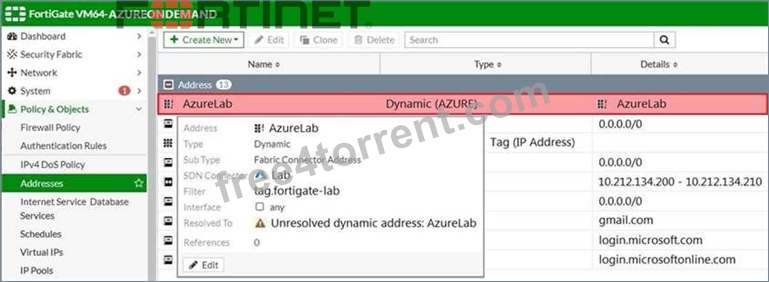
Refer to the exhibit. Your senior administrator successfully configured a FortiGate fabric connector with the Azure resource manager, and created a dynamic address object on the FortiGate VM to connect with a windows server in Microsoft Azure. However, there is now an error on the dynamic address object, and you must resolve the issue.
How do you resolve this issue?
- A. In the Microsoft Azure portal, set the correct tag values for the windows server.
- B. In the Microsoft Azure portal, access the windows server, obtain the private IP address, and assign the IP address under the FortiGate-VM AzureLab address object.
- C. Run diagnose debug application azd -lon FortiGate.
- D. Delete the address object and recreate a new address object with the type set to FQDN.
Answer: B
Explanation:
Explanation
NEW QUESTION # 34
A company deployed a FortiGate-VM with an on-demand license using Amazon Web Services (AWS) Market Place Cloud Formation template. After deployment, the administrator cannot remember the default admin password.
What is the default admin password for the FortiGate-VM instance?
- A. <blank>
- B. admin
- C. The admin password cannot be recovered and the customer needs to deploy the FortiGate-VM again.
- D. The instance-ID value
Answer: D
Explanation:
Explanation/Reference: https://docs.fortinet.com/document/fortigate/6.2.0/aws-cookbook/828256/connecting-to-the- fortigate-vm
NEW QUESTION # 35
An organization deploys a FortiGate-VM (VM04 / c4.xlarge) in Amazon Web Services (AWS) and configures two elastic network interfaces (ENIs). Now, the same organization wants to add additional ENIs to support different workloads in their environment.
Which action can you take to accomplish this?
- A. Create the ENI, attach it to FortiGate, and then restart FortiGate.
- B. Create the ENI and attach it to FortiGate.
- C. None, you cannot create and add additional ENIs to an existing FortiGate-VM.
- D. Create the ENI, shut down FortiGate, attach the ENI to FortiGate, and then start FortiGate.
Answer: B
Explanation:
Explanation
https://docs.fortinet.com/document/fortigate-public-cloud/6.2.0/aws-administration-guide/903457 AWS says that you can attach a network interface to an instance when it's running (hot attach), when it's stopped (warm attach), or when the instance is being launched (cold attach). It applies to windows:
https://docs.aws.amazon.com/AWSEC2/latest/WindowsGuide/best-practices-for-configuring-network-interfaces
NEW QUESTION # 36
You are deploying Amazon Web Services (AWS) GuardDuty to monitor malicious or unauthorized behaviors related to AWS resources. You will also use the Fortinet aws-lambda-guarddutyscript to translate feeds from AWS GuardDuty findings into a list of malicious IP addresses. FortiGate can then consume this list as an external threat feed.
Which Amazon AWS services must you subscribe to in order to use this feature?
- A. GuardDuty, CloudWatch, S3, and DynamoDB.
- B. GuardDuty, CloudWatch, S3, Inspector, WAF, and Shield.
- C. Inspector, Shield, GuardDuty, S3, and DynamoDB.
- D. WAF, Shield, GuardDuty, S3, and DynamoDB.
Answer: B
Explanation:
Explanation/Reference: https://fortinetweb.s3.amazonaws.com/docs.fortinet.com/v2/attachments/ed901ad2-4424-11e9-
94bf-00505692583a/FortiOS_6.2.0_AWS_Cookbook.pdf
NEW QUESTION # 37
Refer to the exhibit.
Your senior administrator successfully configured a FortiGate fabric connector with the Azure resource manager, and created a dynamic address object on the FortiGate VM to connect with a windows server in Microsoft Azure. However, there is now an error on the dynamic address object, and you must resolve the issue.
How do you resolve this issue?
- A. In the Microsoft Azure portal, set the correct tag values for the windows server.
- B. In the Microsoft Azure portal, access the windows server, obtain the private IP address, and assign the IP address under the FortiGate-VM AzureLab address object.
- C. Delete the address object and recreate a new address object with the type set to FQDN.
- D. Run diagnose debug application azd -l on FortiGate.
Answer: B
NEW QUESTION # 38
When configuring the FortiCASB policy, which three configuration options are available? (Choose three.)
- A. Data loss prevention policies
- B. Threat protection policies
- C. Intrusion prevention policies
- D. Antivirus policies
- E. Compliance policies
Answer: A,B,E
NEW QUESTION # 39
You have previously deployed an Amazon Web Services (AWS) transit virtual private cloud (VPC) with a pair of FortiGate firewalls (VM04 / c4.xlarge) as your security perimeter. You are beginning to see high CPU usage on the FortiGate instances.
Which action will fix this issue?
- A. Migrate the transit VPNs to new and larger instances (VM08 / c4.2xlarge).
- B. Convert the transit VPC firewalls into an auto-scaling group and launch additional EC2 instances in that group.
- C. Convert from IPsec tunnels to generic routing encapsulation (GRE) tunnels, for the VPC peering connections.
- D. Convert the c4.xlarge instances to m4.xlarge instances.
Answer: B
Explanation:
Explanation
Multiple FortiGate-VM instances form an Auto Scaling group to provide highly efficient clustering at times of high workloads. FortiGate-VM instances can be scaled out automatically according to predefined workload levels.
https://docs.fortinet.com/document/fortigate-public-cloud/6.2.0/aws-administration-guide/397979/deploying-auto
NEW QUESTION # 40
......
The NSE7_PBC-6.4 exam is intended for professionals who have experience with public cloud security and Fortinet solutions. NSE7_PBC-6.4 exam consists of 60 multiple-choice questions that must be completed in 120 minutes. Fortinet NSE 7 - Public Cloud Security 6.4 certification exam is designed to test the candidate's knowledge of public cloud security concepts and their ability to deploy, configure, and manage Fortinet solutions in a public cloud environment. Successful candidates will have a deep understanding of cloud security best practices, compliance requirements, and the ability to implement strategies to protect cloud-based workloads and data. Fortinet NSE 7 - Public Cloud Security 6.4 certification is highly valued in the industry and can help professionals advance their careers in public cloud security.
The NSE7_PBC-6.4 exam has a comprehensive coverage of critical public cloud security topics such as Configuration Management, Cloud Network Security, Cloud Security Operations, Application Security, and Public Cloud Data Protection. It is designed to help professionals obtain in-depth knowledge and expertise in securing public cloud infrastructures, applications and data, and comply with industry regulations for cloud security.
Realistic Free4Torrent NSE7_PBC-6.4 Dumps PDF - 100% Passing Guarantee: https://realpdf.free4torrent.com/NSE7_PBC-6.4-valid-dumps-torrent.html