

All Obstacles During H12-831_V1.0 Exam Preparation with H12-831_V1.0 Real Test Questions
Fully Updated Free Actual Huawei H12-831_V1.0 Exam Questions
NEW QUESTION # 43
On the OSPF network shown in the figure, the cost values of links are marked. IS-IS Auto FRR is enabled on R1. The primary path from R1 to 10.0.3.3/32 is R1 # R2 # R3, and the backup path is R1 # R4 # R2 # R3.
Is this statement TRUE or FALSE?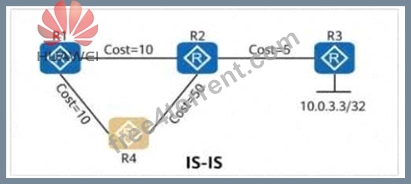
- A. TRUE
- B. FALSE
Answer: B
Explanation:
Comprehensive and Detailed In-Depth Explanation:
Step 1: Analyzing the Primary Path
* The given network uses IS-IS Auto FRR, which ensures a backup route in case of failure.
* The shortest path from R1 to 10.0.3.3/32 is calculated based on the OSPF link costs:
* Path 1 (Primary Path): R1 # R2 # R3
* Cost: 10 (R1#R2) + 5 (R2#R3) = 15 #
Step 2: Checking the Backup Path
* The statement claims that the backup path is R1 # R4 # R2 # R3. Let's calculate the cost:
* Path 2 (Backup Path via R4): R1 # R4 # R2 # R3
* Cost: 10 (R1#R4) + 50 (R4#R2) + 5 (R2#R3) = 65 # (Too high)
* The backup path should be an alternative shortest path that is as close as possible to the primary path in cost.
* R1 # R4 # R2 # R3 is not a feasible backup path because the cost (65) is significantly higher than the primary path (15).
Step 3: Correct Backup Path Selection
* If IS-IS Auto FRR is enabled, a feasible backup path should have a cost close to the primary path.
* In this scenario, no viable alternative path meets the Auto FRR requirements efficiently.
* The given backup path is incorrect.
Final answer: # FALSE (Option B)
References:
* HCIP-Datacom-Advanced Routing & Switching Technology V1.0 - IS-IS Auto FRR Mechanism
* OSPF Route Selection and Fast Reroute Principles
* OSPF and IS-IS Path Cost Calculation
NEW QUESTION # 44
If faced with a complex network failure, and it is estimated that the troubleshooting cannot be completed in a short period of time, and the user urgently needs to restore the availability of the network, then the correct approach is.
- A. Always try to troubleshoot without informing the user of the current troubleshooting difficulty
- B. Communicate with users whether it is possible to skip the faulty node and build an alternative network environment
- C. Directly build an alternative network environment without notifying customers
- D. Tell the user it's not possible
Answer: B
NEW QUESTION # 45
Regarding the role of ping and tracert, which of the following statements is correct?
- A. Ping verifies the reachability from the local end to the opposite end, it does not mean that the opposite end is reachable from the local end
- B. Tracert must be able to trace every hop IP address from source to destination
- C. Ping detects the two-way reachability between the correct end and the one-way icmp echo request packet
- D. Tracert has the same function as ping, but the name is different
Answer: A
NEW QUESTION # 46
Please match the characteristics and functions of the IS-IS protocol.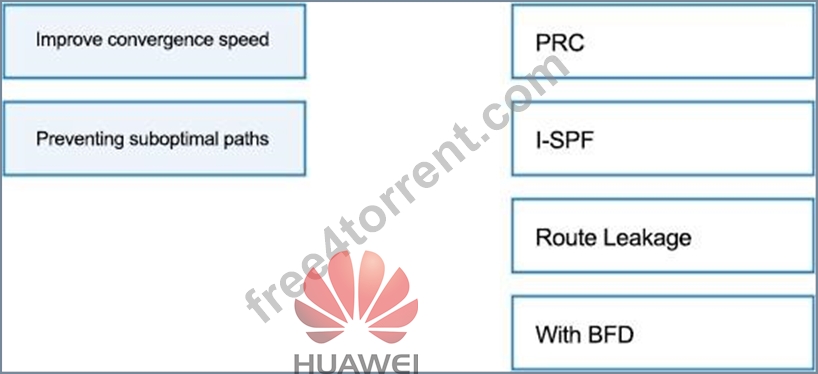
Answer:
Explanation: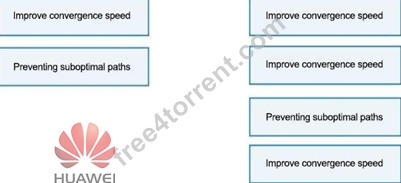
NEW QUESTION # 47
The BGP protocol supports the use of the "filter-policy acl-number import" command to subtract the received routing information. The value range of acl-number is 2000~3999.
- A. True
- B. False
Answer: B
NEW QUESTION # 48
During the test phase of the cutover, the criteria to indicate that the test has been completed are:
- A. Test that the network service is normal as the standard
- B. IPThe configuration view result of the device is normal as the standard
- C. The upper-layer application service test carried by the network is normal as the standard
Answer: C
Explanation:
D, check that the network is running normally as a standard
NEW QUESTION # 49
In the DU label distribution mode, if the Liberal retention mode is adopted, the device will retain all the labels distributed by the LDP Peer, regardless of whether the LDP Peer is the optimal next-hop to reach the target network segment.
- A. FALSE
- B. TRUE
Answer: B
NEW QUESTION # 50
In an MPLS VPN network, data packets are forwarded when they enter the public network. Will be encapsulated with two layers of MPLS labels. Which of the following description is correct about the processing of the data packet? (Multiple choice)
- A. The packet is forwarded to the Egress PE device after the outer label pops up on the penultimate hop device
- B. The Egress PE device correctly sends the data packet to the corresponding VPN according to the inner label
- C. The outer label of the packet received by the penultimate hop device is 3
- D. The Egress PE device receives untagged IP packets
Answer: A,B
NEW QUESTION # 51
Display interface GE0/0/0 once, and find that the Total Eror count (the total number of error packets on the physical layer of the interface) is not 0. At this point, it can be concluded that the current fault has not disappeared.
- A. FALSE
- B. TRUE
Answer: B
NEW QUESTION # 52
Which of the following reasons may cause the hosts in the same--VLAN LAN to fail to communicate with each other
- A. the wrong port is configured on the machine, andMA, Caddress binding
- B. port isolation is configured on the switch
- C. switchMA, Caddress learning errors
- D. interface is artificialshutdownor the physical interface is damaged
Answer: A,B,C,D
NEW QUESTION # 53
As shown in the figure, PE1 and PE2 and their respective CEs exchange private network routing information through OSPF, and the same DomainID is configured on PE1 and PE2. When routes are imported from BGP to OSPF on PE2, which of the following types of SA may be delivered to CE2? (Multiple choice)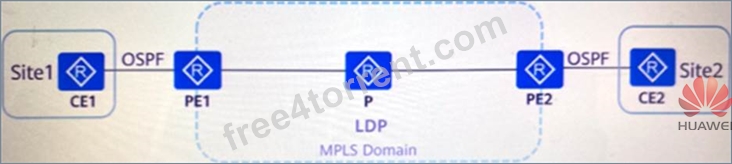
- A. Type1 LSA
- B. Type7 LSA
- C. Type3 LSA
- D. Type5 LSA
Answer: B,C,D
NEW QUESTION # 54
The link status information between different S.4S processes of the routers around the Taiwan and Taiwan is considered to be sound insulation.
- A. False
- B. True
Answer: B
NEW QUESTION # 55
The network administrator has deployed the DHCP snooping function on the access switch.
Which of the following solutions can be used to reduce the impact of attackers maliciously applying for IP addresses and causing DHCP Server denial of service? (Multiple choice)
- A. Limit the number of MAC addresses learned by the switch interface through DHCP Snooping
- B. Configure DHCP Snooping to check the CHADDR field in the DHCP Request message
- C. Set the interface on the switch that is connected to the legitimate DHCP server as a trusted interface
- D. Enable the device to generate static MAC entries for interfaces based on the DHCP Snooping binding table.
Answer: A,B,D
NEW QUESTION # 56
On the OSPF network shown in the figure, area 1 is an NSSA, area 2 is a common area, and R4 imports an external route 10.0.4.4/32. The router ID of each router is 10.0.X.X, where X is the router number. If the asbr-summary 10.0.4.0 255.255.255.0 command is run in the OSPF processes of R1 and R3, which of the following routers have the route 10.0.4.0/24 in their routing tables?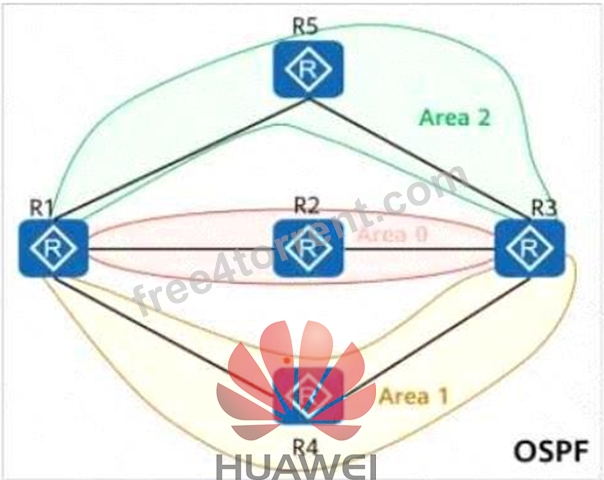
- A. R2
- B. R1
- C. R5
- D. R3
Answer: B,D
Explanation:
Step 1: Understanding OSPF Areas and Summarization
* Area 1 (NSSA - Not So Stubby Area)
* Allows external routes but converts Type-5 LSAs into Type-7 LSAs.
* External routes must be translated by an ABR into Type-5 LSAs before being propagated into other areas.
* Area 2 (Common Area - Regular OSPF Area)
* Supports both inter-area and external routes.
* asbr-summary 10.0.4.0 255.255.255.0 Command
* This command summarizes all external routes within 10.0.4.0/24 into a single summarized route.
* Since it is applied on R1 and R3, these routers will advertise 10.0.4.0/24 instead of 10.0.4.4/32 to their respective areas.
Step 2: Route Distribution Analysis
* R4 (Originating Router in NSSA - Area 1)
* R4 injects 10.0.4.4/32 as a Type-7 LSA into Area 1.
* R1 (ABR between Area 1 & Area 0, Summarizing Route)
* Since R1 is an ABR, it translates Type-7 LSAs from Area 1 into a summarized Type-5 LSA (10.0.4.0/24) for Area 0.
* # R1 has 10.0.4.0/24 in its routing table.
* R2 (Inside Backbone Area 0, No ASBR Summary Applied Here)
* R2 only receives Type-5 LSAs from R1 but does not summarize them.
* Since R2 is not explicitly summarizing, it will likely still see 10.0.4.4/32 rather than 10.0.4.0
/24.
* # R2 does not have 10.0.4.0/24.
* R3 (ABR between Area 0 & Area 2, Summarizing Route)
* R3 is also an ABR and has the asbr-summary 10.0.4.0/24 command configured.
* It will advertise the summarized route 10.0.4.0/24 into Area 2.
* # R3 has 10.0.4.0/24 in its routing table.
* R5 (Inside Area 2, No Direct Connectivity to External Routes)
* Since R3 summarizes 10.0.4.0/24, R5 (inside Area 2) will receive only summarized routes.
* # R5 has 10.0.4.0/24.
Final answer: # R1, R3 (Option A, C)
References:
* HCIP-Datacom-Advanced Routing & Switching Technology V1.0 - OSPF Route Summarization
* OSPF NSSA and Type-7 to Type-5 LSA Translation
NEW QUESTION # 57
A network engineer provides a troubleshooting report after rectifying a fault. The actual network is simplified into the one shown in the figure, where:
* R1 and R2 both have OSPF enabled.
* R1 and R2 function as the gateways for PC1 and PC2, respectively.
Given this, which of the following statements are true?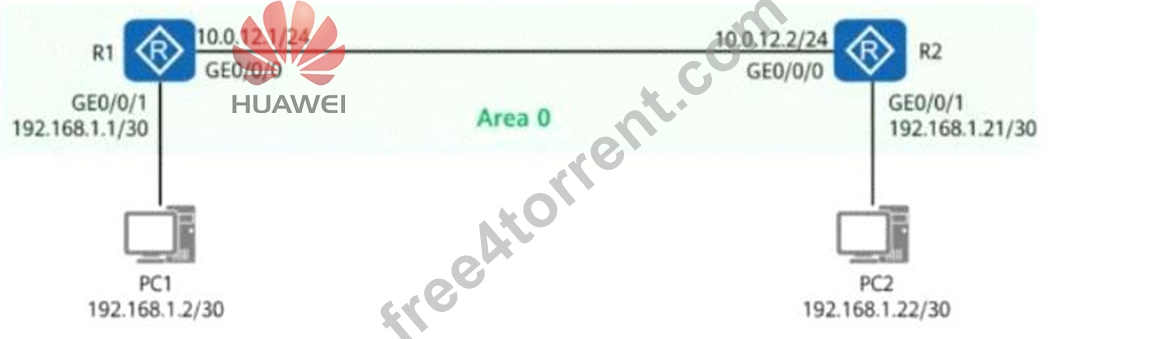
Options:
- A. R1 can ping 192.168.1.22.
- B. R1 can ping 192.168.1.21.
- C. PC1 and PC2 cannot ping each other.
- D. R2 can ping 192.168.1.2.
Answer: A,B,D
Explanation:
Comprehensive and Detailed In-Depth Explanation:
1. Understanding the Network Topology
* R1 and R2 are OSPF-enabled routers connected via the 10.0.12.0/24 subnet (Area 0).
* PC1 (192.168.1.2/30) is connected to R1 via GE0/0/1.
* PC2 (192.168.1.22/30) is connected to R2 via GE0/0/1.
* OSPF ensures that R1 and R2 know about each other's directly connected networks.
2. Analyzing Connectivity
* Can R1 ping 192.168.1.22 (PC2)?
* Yes, if routing is properly configured.
* OSPF ensures that R1 learns about 192.168.1.22 from R2.
* Since R1 has a route to 192.168.1.22 via R2, it can ping PC2 successfully.
* # Option A is correct.
* Can R1 ping 192.168.1.21 (R2's interface)?
* Yes, since R1 and R2 are OSPF neighbors.
* R1 learns 192.168.1.21 via OSPF and can reach it directly.
* # Option B is correct.
* Can R2 ping 192.168.1.2 (PC1)?
* Yes, since OSPF ensures that R2 learns about 192.168.1.2 from R1.
* Since R2 has a route to 192.168.1.2 via R1, it can ping PC1 successfully.
* # Option C is correct.
* Can PC1 and PC2 ping each other?
* Yes, if default gateways and routing are configured correctly.
* If R1 and R2 can ping each other and forward packets, PC1 and PC2 should be able to communicate.
* # Option D is incorrect because PC1 and PC2 should be able to ping each other.
Final Answer:
# A, B, and C are correct.
HCIP-Datacom-Advanced Routing & Switching Technology References:
* OSPF Inter-Router Communication and Route Advertisement
* Default Gateway and Routing in Multi-Router Networks
* Troubleshooting End-to-End Connectivity in Routed Networks
NEW QUESTION # 58
......
Validate your H12-831_V1.0 Exam Preparation with H12-831_V1.0 Practice Test: https://realpdf.free4torrent.com/H12-831_V1.0-valid-dumps-torrent.html