

2025 Correct and Up-to-date Microsoft AZ-305 BrainDumps
Current AZ-305 dumps Preparation through Our Practice Test
To prepare for the Microsoft AZ-305 exam, candidates should have a solid understanding of Microsoft Azure and its services. They should also have experience working with Azure infrastructure and architecture, as well as designing and implementing solutions using Azure services. Microsoft provides various resources to help candidates prepare for the exam, including official documentation, training courses, practice tests, and community forums.
Microsoft AZ-305 exam is a challenging test that requires extensive preparation. Candidates will need to have hands-on experience with Azure services and be familiar with best practices for designing solutions on the platform. Microsoft offers a range of training resources, including online courses, practice exams, and study guides, to help candidates prepare for the exam.
NEW QUESTION # 175
You are designing a storage solution that will ingest, store, and analyze petabytes (PBs) of structured, semi- structured and unstructured text data. The analyzed data will be offloaded to Azure Data Lake Storage Gen2 for long-term retention.
You need to recommend a storage and analytics solution that meets the following requirements:
* Stores the processed data
* Provides interactive analytics
* Supports manual scaling, built-in autoscaling. and custom autoscaling What should you include in the recommendation? To answer, select the appropriate options in the answer area.
NOTE Each correct selection is worth one point.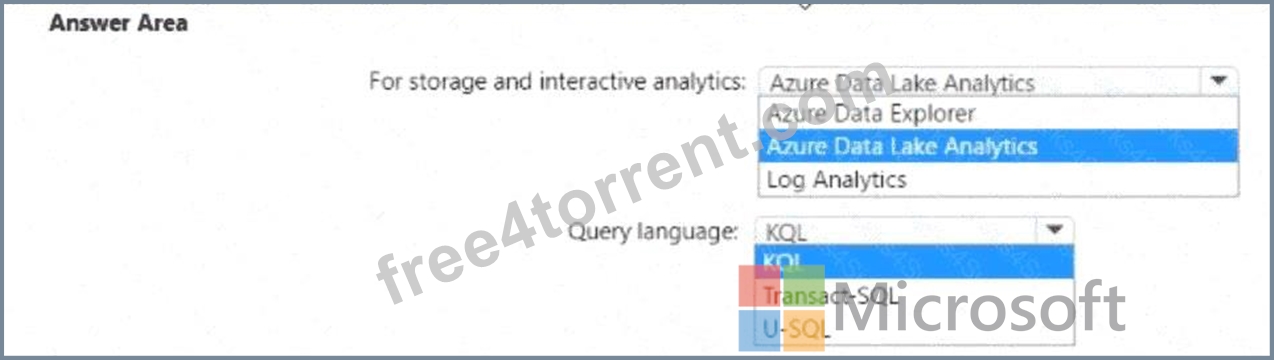
Answer:
Explanation: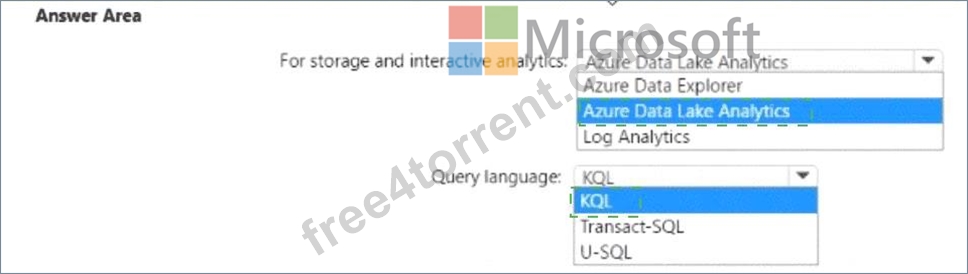
Explanation:
NEW QUESTION # 176
You are designing an Azure web app.
You plan to deploy the web app to the North Europe Azure region and the West Europe Azure region.
You need to recommend a solution for the web app. The solution must meet the following requirements:
Users must always access the web app from the North Europe region, unless the region fails.
The web app must be available to users if an Azure region is unavailable.
Deployment costs must be minimized.
What should you include in the recommendation? To answer, select the appropriate options in the answer area.
NOTE: Each correct selection is worth one point.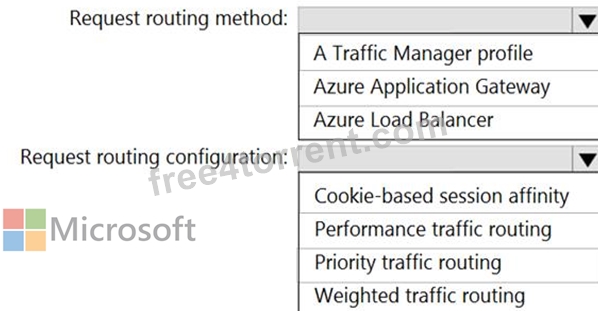
Answer:
Explanation: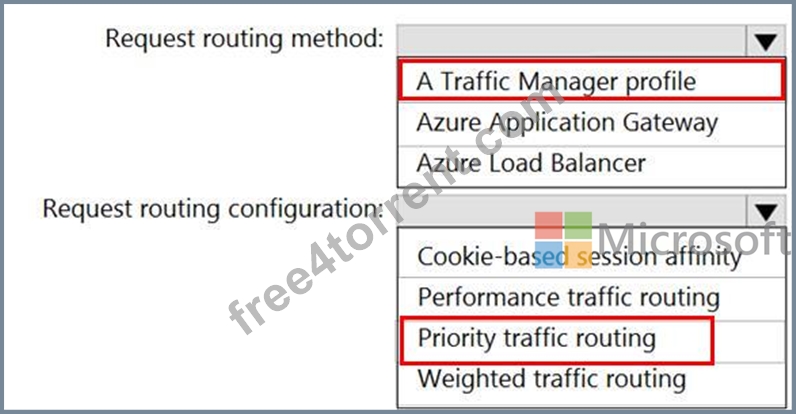
NEW QUESTION # 177
How should the migrated databases DB1 and DB2 be implemented in Azure?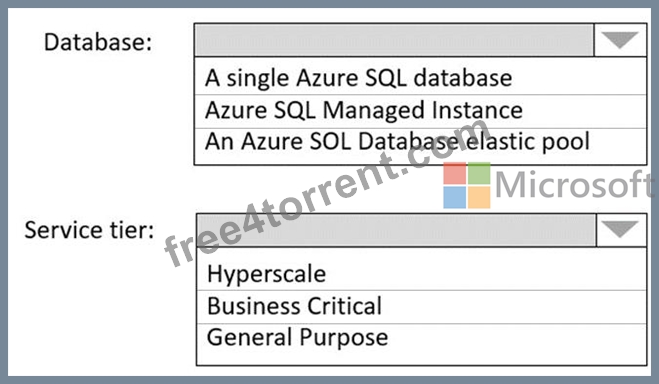
Answer:
Explanation: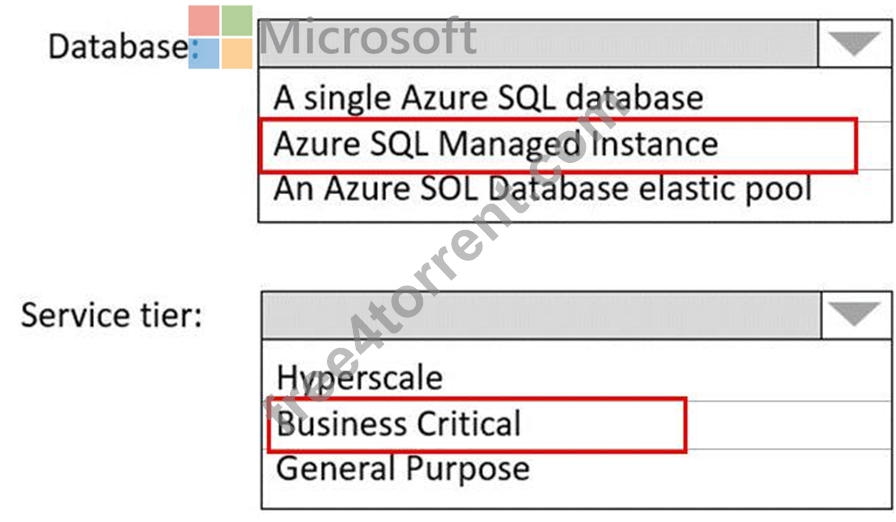
Reference:
https://docs.microsoft.com/en-us/azure/azure-sql/database/auto-failover-group-overview
https://docs.microsoft.com/en-us/azure/azure-sql/managed-instance/sql-managed-instance-paas-overview
NEW QUESTION # 178
Note: This question is part of a series of questions that present the same scenario. Each question in the series contains a unique solution that might meet the stated goals. Some question sets might have more than one correct solution, while others might not have a correct solution.
After you answer a question in this section, you will NOT be able to return to it. As a result, these questions will not appear in the review screen. You have an Azure Storage account that contains two 1-GB data files named File1 and File2. The data files are set to use the archive access tier. You need to ensure that File1 is accessible immediately when a retrieval request is initiated. Solution: For File1, you set Access tier to Cool.
Does this meet the goal?
- A. No
- B. Yes
Answer: B
Explanation:
The data in the cool tier is "considered / intended to be stored for 30 days". But this is not a must. You can store data indefinitely in the cool tier. The mentioned reference (see below) even gives an example of large scientific or otherwise large data which is stored for long duration in the cool tier.
https://docs.microsoft.com/en-us/azure/storage/blobs/storage-blob-storage-tiers?tabs=azure-portal
NEW QUESTION # 179
Hotspot Question
You need to implement the Azure RBAC role assignment. The solution must meet the authentication and authorization requirements.
How many assignment should you configure for the Network Contributor role for Role1? To answer, select appropriate in the answer area.
NOTE: Each correct selection is worth one point.
Answer:
Explanation: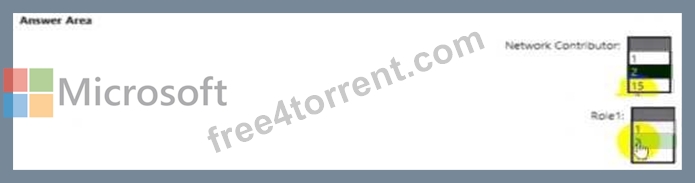
NEW QUESTION # 180
You have an Azure subscription named Subscription1 that is linked to a hybrid Azure Active Directory (Azure AD) tenant.
You have an on-premises datacenter that does NOT have a VPN connection to Subscription1. The datacenter contains a computer named Server1 that has Microsoft SQL Server 2016 installed. Server1 is prevented from accessing the internet.
An Azure logic app named LogicApp1 requires write access to a database on Server1.
You need to recommend a solution to provide LogicApp1 with the ability to access Server1.
What should you recommend deploying on-premises and in Azure? To answer, select the appropriate options in the answer area.
NOTE: Each correct selection is worth one point.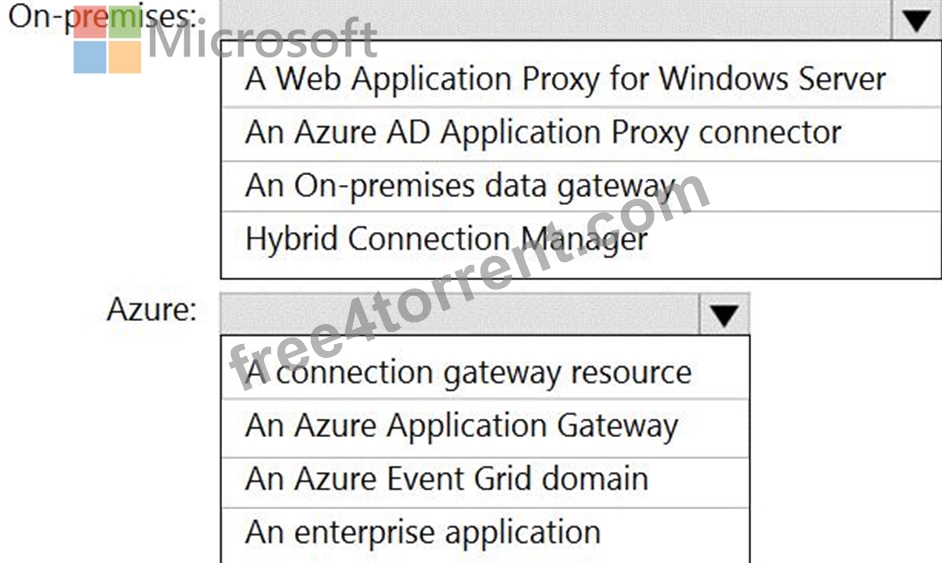
Answer:
Explanation: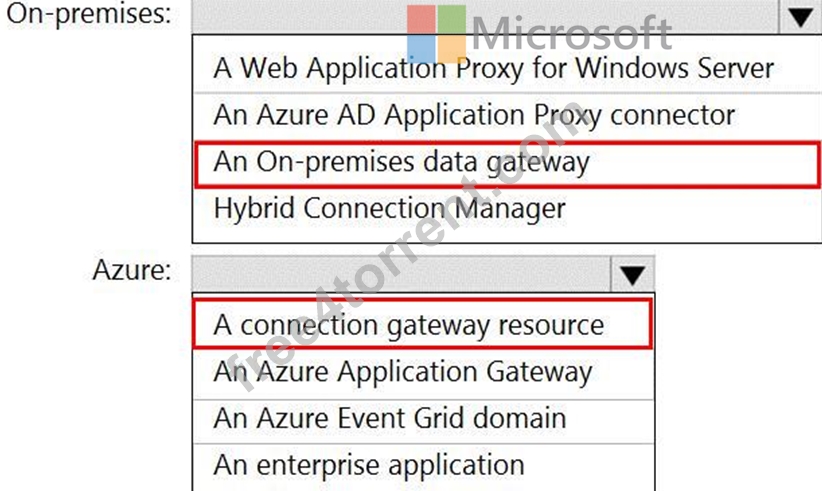
Reference:
https://docs.microsoft.com/en-us/azure/connectors/connectors-create-api-sqlazure
NEW QUESTION # 181
You have an Azure subscription.
You plan to deploy two 100-virtual machine deployments as shown in the following table.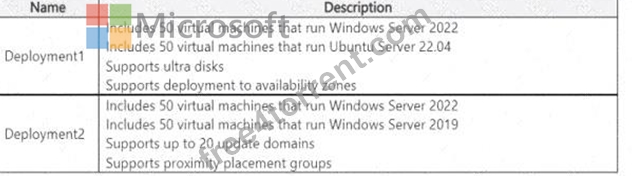
You need to recommend a virtual machine grouping solution for the deployments.
What should you include in the recommendation for each deployment? To answer, select the appropriate options in the answer area.
NOTE: Each correct selection is worth one point.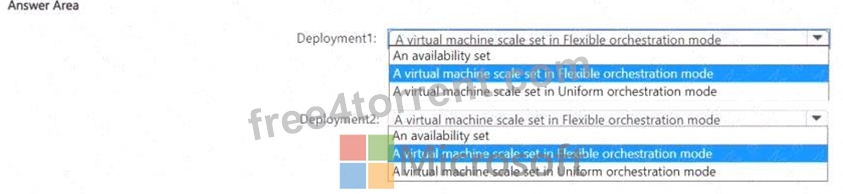
Answer:
Explanation: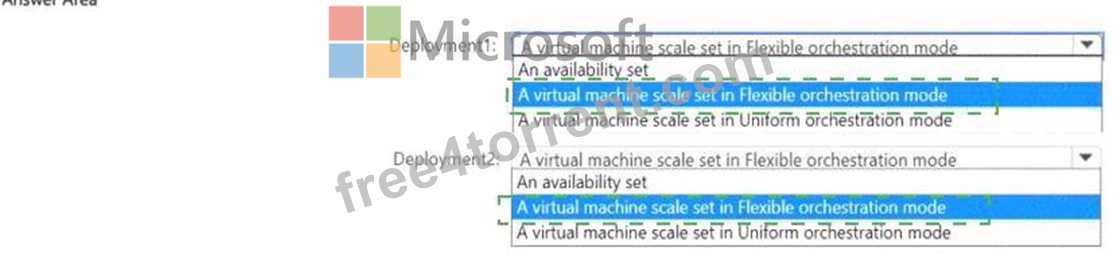
Explanation:
NEW QUESTION # 182
You are planning an Azure IoT Hub solution that will include 50,000 IoT devices.
Each device will stream data, including temperature, device ID, and time dat a. Approximately 50,000 records will be written every second. The data will be visualized in near real time.
You need to recommend a service to store and query the data.
Which two services can you recommend? Each correct answer presents a complete solution.
NOTE: Each correct selection is worth one point.
- A. Azure Event Grid
- B. Azure Cosmos DB SQL API
- C. Azure Time Series Insights
- D. Azure Table Storage
Answer: B,C
Explanation:
D: Time Series Insights is a fully managed service for time series data. In this architecture, Time Series Insights performs the roles of stream processing, data store, and analytics and reporting. It accepts streaming data from either IoT Hub or Event Hubs and stores, processes, analyzes, and displays the data in near real time.
C: The processed data is stored in an analytical data store, such as Azure Data Explorer, HBase, Azure Cosmos DB, Azure Data Lake, or Blob Storage.
Reference:
https://docs.microsoft.com/en-us/azure/architecture/data-guide/scenarios/time-series
NEW QUESTION # 183
You are evaluating whether to use Azure Traffic Manager and Azure Application Gateway to meet the connection requirements for App1.
What is the minimum numbers of instances required for each service? To answer, select the appropriate options in the answer area.
NOTE: Each correct selection is worth one point.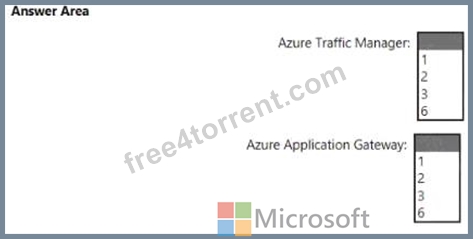
Answer:
Explanation: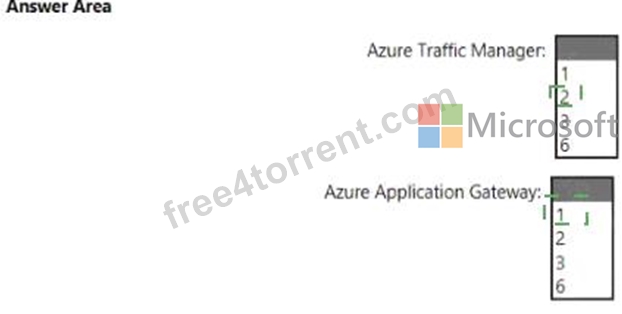
Explanation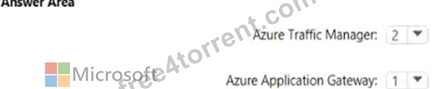
NEW QUESTION # 184
You plan to deploy an application named App1 that will run in containers on Azure Kubernetes Service (AKS) clusters. The AKS clusters will be distributed across four Azure regions.
You need to recommend a storage solution to ensure that updated container images are replicated automatically to all the Azure regions hosting the AKS clusters.
Which storage solution should you recommend?
- A. Azure Cache for Redis
- B. Premium SKU Azure Container Registry
- C. Azure Content Delivery Network (CON)
- D. geo-redundant storage (GRS) accounts
Answer: B
NEW QUESTION # 185
Note: This question is part of a series of questions that present the same scenario. Each question in the series contains a unique solution that might meet the stated goals. Some question sets might have more than one correct solution, while others might not have a correct solution.
After you answer a question in this section, you will NOT be able to return to it. As a result, these questions will not appear in the review screen.
You have an Azure Storage account that contains two 1-GB data files named File1 and File2. The data files are set to use the archive access tier.
You need to ensure that File1 is accessible immediately when a retrieval request is initiated.
Solution: For File1, you set Access tier to Cool.
Does this meet the goal?
- A. No
- B. Yes
Answer: B
Explanation:
The data in the cool tier is "considered / intended to be stored for 30 days". But this is not a must. You can store data indefinitely in the cool tier. The mentioned reference (see below) even gives an example of large scientific or otherwise large data which is stored for long duration in the cool tier.
https://docs.microsoft.com/en-us/azure/storage/blobs/storage-blob-storage-tiers?tabs=azure-portal
NEW QUESTION # 186
Your on-premises network contains a file server named Server1 that stores 500 GB of data.
You need to use Azure Data Factory to copy the data from Server1 to Azure Storage.
You add a new data factory.
What should you do next? To answer, select the appropriate options in the answer area.
NOTE: Each correct selection is worth one point.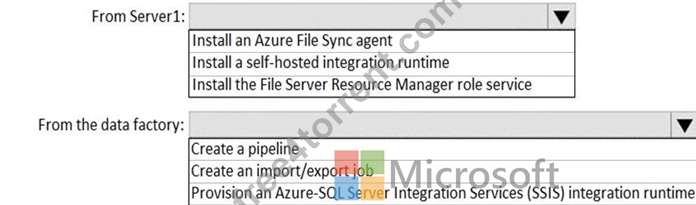
Answer:
Explanation: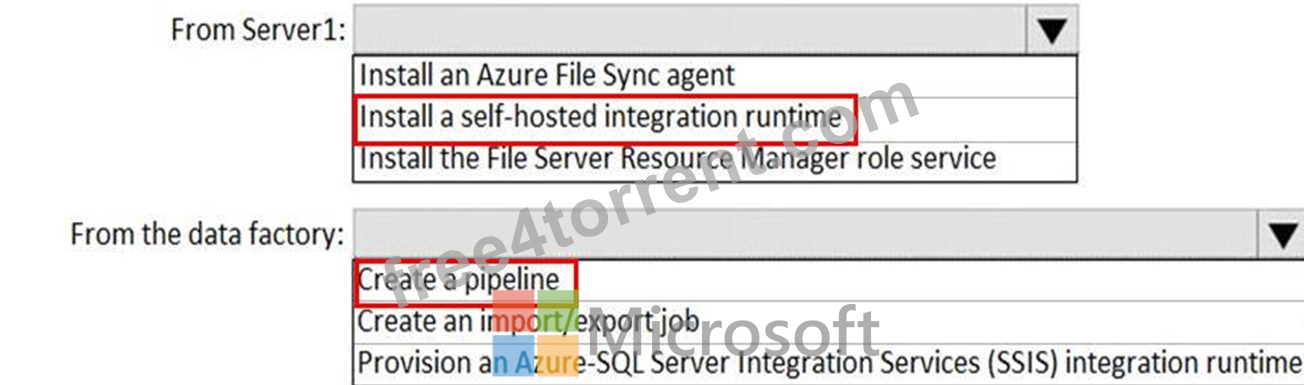
Reference:
https://docs.microsoft.com/en-us/azure/machine-learning/team-data-science-process/move-sql-azure-adf
https://docs.microsoft.com/pl-pl/azure/data-factory/tutorial-hybrid-copy-data-tool
NEW QUESTION # 187
Hotspot Question
You have an Azure subscription.
You are designing a solution for containerized apps. The solution must meet the following requirements:
- Automatically scale the apps by creating additional instances.
- Minimize administrative effort to maintain nodes and clusters.
- Ensure that containerized apps are highly available across multiple
availability zones.
- Provide a central location for the lifecycle management and storage
of container images.
What should you include in the solution? To answer, select the appropriate options in the answer area.
NOTE: Each correct selection is worth one point.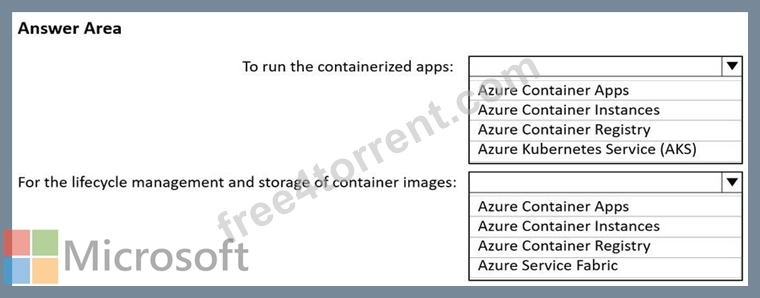
Answer:
Explanation: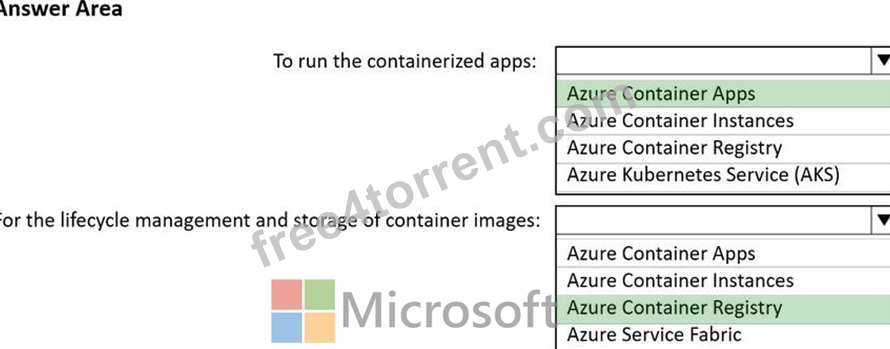
NEW QUESTION # 188
You have an Azure Active Directory (Azure AD) tenant named contoso.com that has a security group named Group'. Group i is configured Tor assigned membership. Group I has 50 members. including 20 guest users.
You need To recommend a solution for evaluating the member ship of Group1. The solution must meet the following requirements:
* The evaluation must be repeated automatically every three months
* Every member must be able to report whether they need to be in Group1
* Users who report that they do not need to be in Group 1 must be removed from Group1 automatically
* Users who do not report whether they need to be m Group1 must be removed from Group1 automatically.
What should you include in me recommendation?
- A. implement Azure AU Identity Protection.
- B. Change the Membership type of Group1 to Dynamic User.
- C. Implement Azure AD Privileged Identity Management.
- D. Create an access review.
Answer: D
Explanation:
https://docs.microsoft.com/en-us/azure/active-directory/governance/access-reviews-overview#learn-about-access-reviews Have reviews recur periodically: You can set up recurring access reviews of users at set frequencies such as weekly, monthly, quarterly or annually, and the reviewers will be notified at the start of each review. Reviewers can approve or deny access with a friendly interface and with the help of smart recommendations.
An administrator creates an access review of Group C with 50 member users and 25 guest users. Makes it a self-review. 50 licenses for each user as self-reviewers.* https://docs.microsoft.com/en-us/azure/active-directory/governance/access-reviews-overview#example-license-scenarios There are 4 requirements and every single one is only met by access reviews. https://docs.microsoft.com/en-us/azure/active-directory/governance/access-reviews-overview#when-should-you-use-access-reviews Dynamic User is needed if a user must be automatically granted access on base of its attributes (department, jobtitle, location, etc.) https://techcommunity.microsoft.com/t5/itops-talk-blog/dynamic-groups-in-azure-ad-and-microsoft-365/ba-p/2267494 Implementing Azure AD PIM is no solution and absolutely not necessary for access reviews. https://docs.microsoft.com/en-us/azure/active-directory/governance/access-reviews-overview#where-do-you-create-reviews
NEW QUESTION # 189
You are designing a virtual machine that will run Microsoft SQL Server and will contain two data disks. The first data disk will store log files, and the second data disk will store data. Both disks are P40 managed disks.
You need to recommend a caching policy for each disk. The policy must provide the best overall performance for the virtual machine.
Which caching policy should you recommend for each disk? To answer, drag the appropriate policies to the correct disks. Each policy may be used once, more than once, or not at all. You may need to drag the split bar between panes or scroll to view content.
NOTE: Each correct selection is worth one point.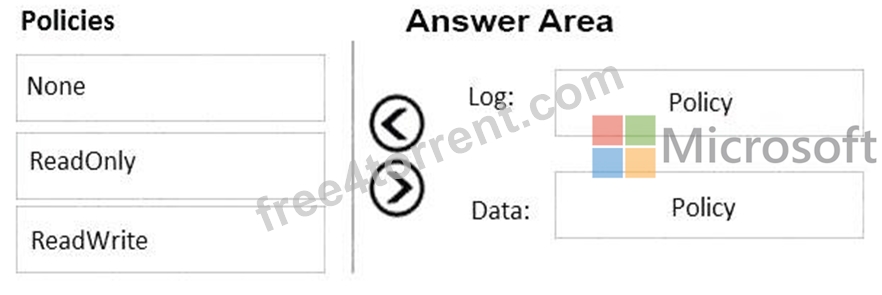
Answer:
Explanation: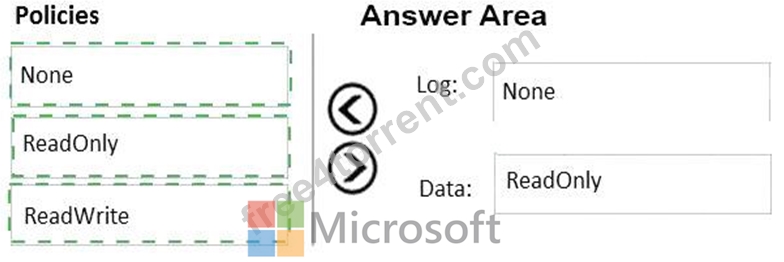
Explanation: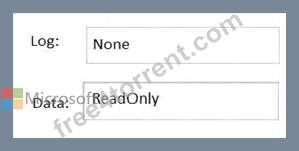
References:
https://docs.microsoft.com/en-us/azure/virtual-machines/windows/sql/virtual-machines-windows-sql- performance
NEW QUESTION # 190
You need to recommend a solution that meets the file storage requirements for App2.
What should you deploy to the Azure subscription and the on-premises network? To answer, drag the appropriate services to the correct locations. Each service may be used once, more than once, or not at all.
You may need to drag the split bar between panes or scroll to view content.
NOTE: Each correct selection is worth one point.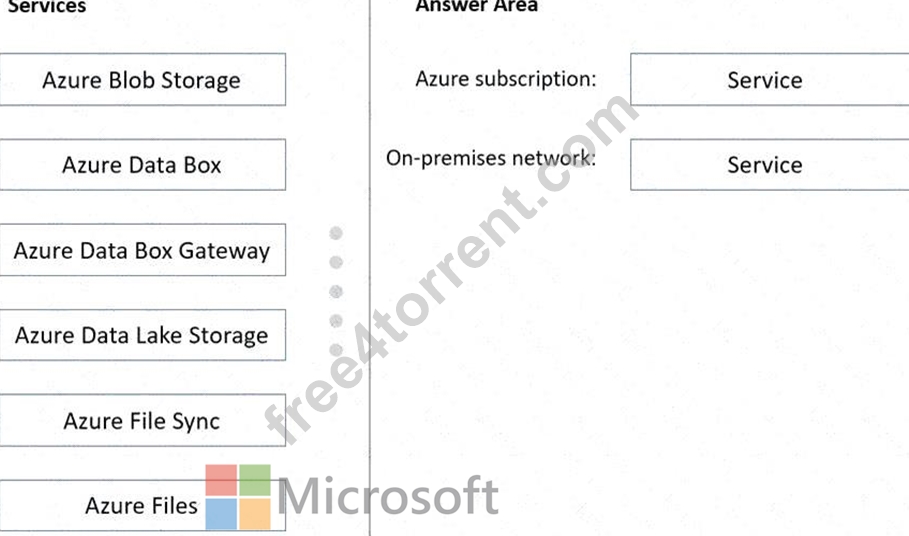
Answer:
Explanation: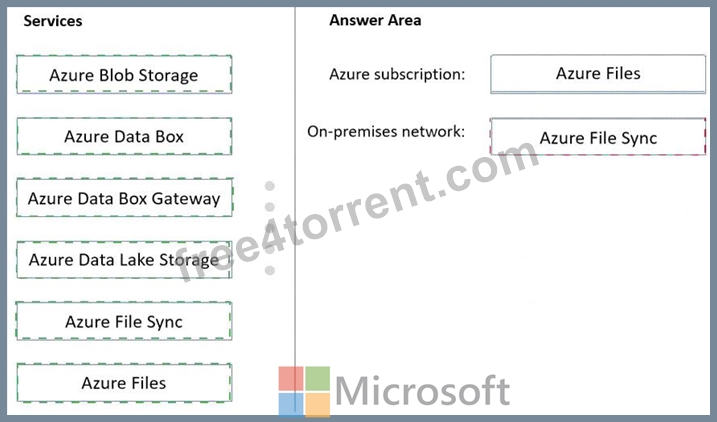
Explanation: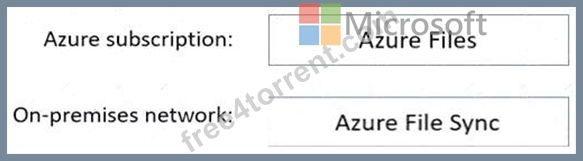
Box 1: Azure Files
Scenario: App2 has the following file storage requirements:
* Save files to an Azure Storage account.
* Replicate files to an on-premises location.
* Ensure that on-premises clients can read the files over the LAN by using the SMB protocol.
Box 2: Azure File Sync
Use Azure File Sync to centralize your organization's file shares in Azure Files, while keeping the flexibility, performance, and compatibility of an on-premises file server. Azure File Sync transforms Windows Server into a quick cache of your Azure file share. You can use any protocol that's available on Windows Server to access your data locally, including SMB, NFS, and FTPS. You can have as many caches as you need across the world.
Reference:
https://docs.microsoft.com/en-us/azure/storage/file-sync/file-sync-deployment-guide
NEW QUESTION # 191
Hotspot Question
You have 10 on-premises servers that run Windows Server.
You need to perform daily backups of the servers to a Recovery Services vault. The solution must meet the following requirements:
- Back up all the files and folders on the servers.
- Maintain three copies of the backups in Azure.
- Minimize costs.
What should you configure? To answer, select the appropriate options in the answer area.
NOTE: Each correct selection is worth one point.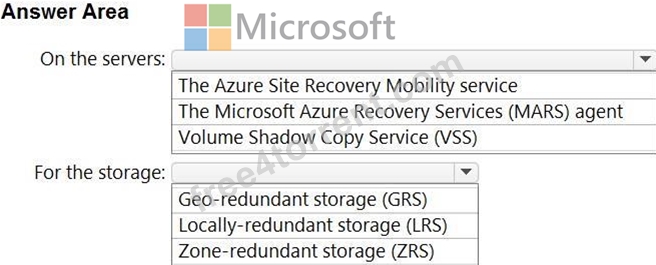
Answer:
Explanation: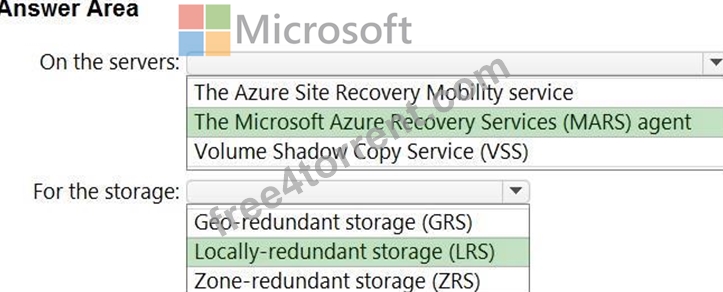
NEW QUESTION # 192
A company plans to implement an HTTP-based API to support a web app. The web app allows customers to check the status of their orders.
The API must meet the following requirements:
* Implement Azure Functions
* Provide public read-only operations
* Do not allow write operations
You need to recommend configuration options.
What should you recommend? To answer, configure the appropriate options in the dialog box in the answer area.
NOTE: Each correct selection is worth one point.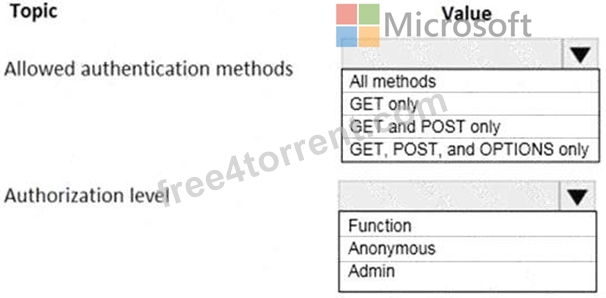
Answer:
Explanation: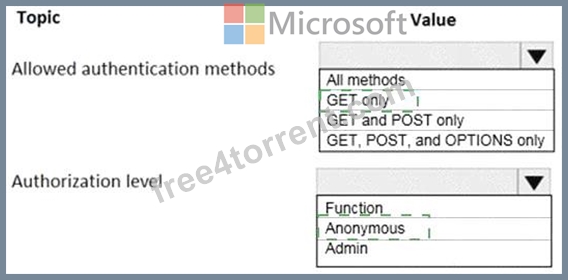
Explanation: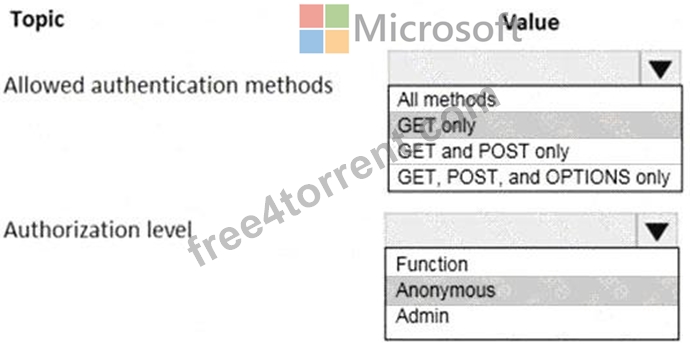
Allowed authentication methods: GET only
Authorization level: Anonymous
The option is Allow Anonymous requests. This option turns on authentication and authorization in App Service, but defers authorization decisions to your application code. For authenticated requests, App Service also passes along authentication information in the HTTP headers.
This option provides more flexibility in handling anonymous requests.
rences:
https://docs.microsoft.com/en-us/azure/app-service/overview-authentication-authorization
NEW QUESTION # 193
You have the Free edition of a hybrid Azure Active Directory (Azure AD) tenant. The tenant uses password hash synchronization.
You need to recommend a solution to meet the following requirements:
* Prevent Active Directory domain user accounts from being locked out as the result of brute force attacks targeting Azure AD user accounts.
* Block legacy authentication attempts to Azure AD integrated apps.
* Minimize costs.
What should you recommend for each requirement? To answer, select the appropriate options in the answer area.
NOTE: Each correct selection is worth one point.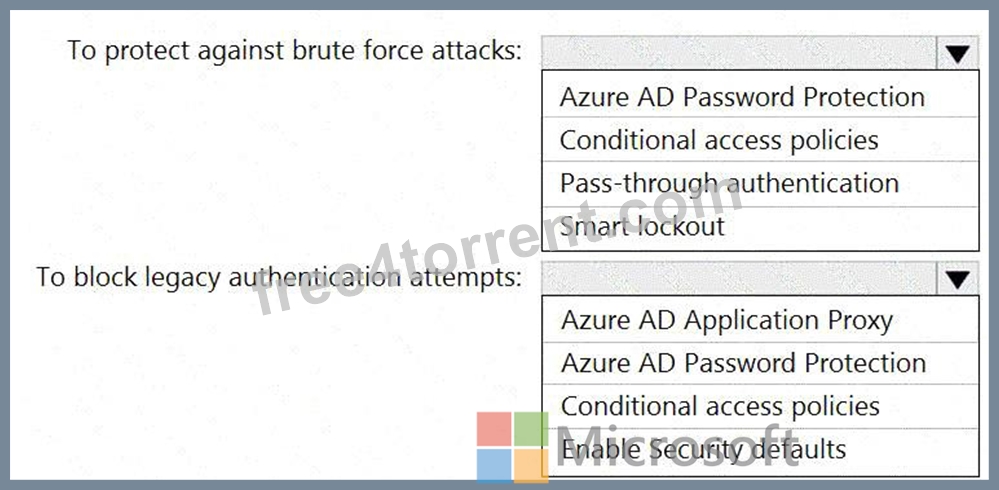
Answer:
Explanation: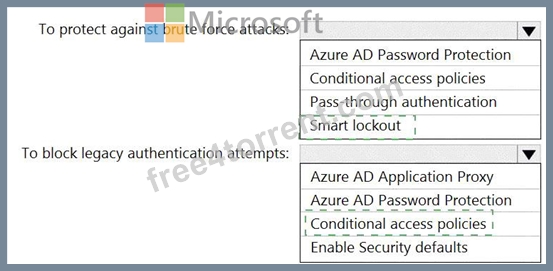
Explanation: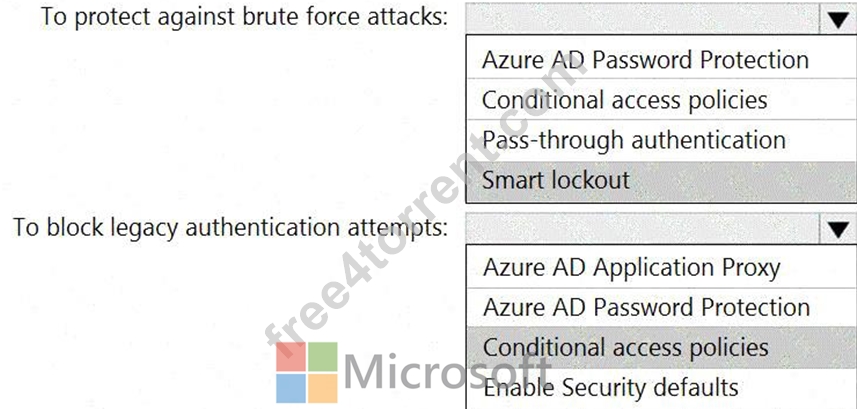
Box 1: Smart lockout
Smart lockout helps lock out bad actors that try to guess your users' passwords or use brute-force methods to get in. Smart lockout can recognize sign-ins that come from valid users and treat them differently than ones of attackers and other unknown sources. Attackers get locked out, while your users continue to access their accounts and be productive.
Box 2: Conditional access policies
If your environment is ready to block legacy authentication to improve your tenant's protection, you can accomplish this goal with Conditional Access.
How can you prevent apps using legacy authentication from accessing your tenant's resources? The recommendation is to just block them with a Conditional Access policy. If necessary, you allow only certain users and specific network locations to use apps that are based on legacy authentication.
Reference:
https://docs.microsoft.com/en-us/azure/active-directory/authentication/howto-password-smart-lockout
https://docs.microsoft.com/en-us/azure/active-directory/conditional-access/block-legacy-authentication
NEW QUESTION # 194
You have five .NET Core applications that run on 10 Azure virtual machines in the same subscription.
You need to recommend a solution to ensure that the applications can authenticate by using the same Azure Active Directory (Azure AD) identity. The solution must meet the following requirements:
* Ensure that the applications can authenticate only when running on the 10 virtual machines.
* Minimize administrative effort.
What should you include in the recommendation? To answer, select the appropriate options in the answer area.
NOTE: Each correct selection is worth one point.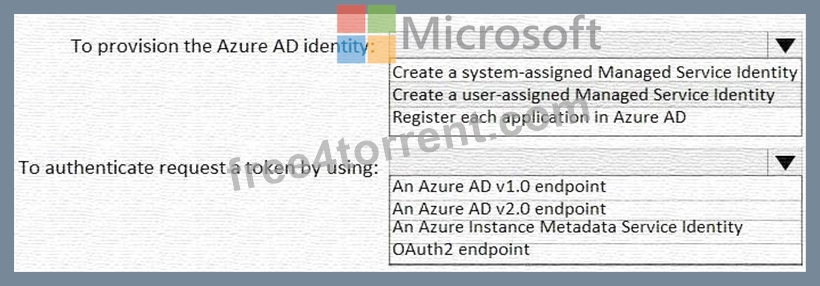
Answer:
Explanation: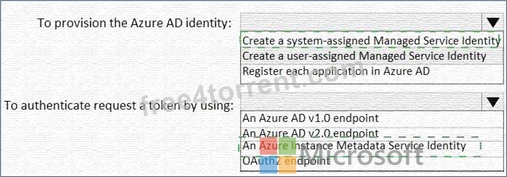
Explanation: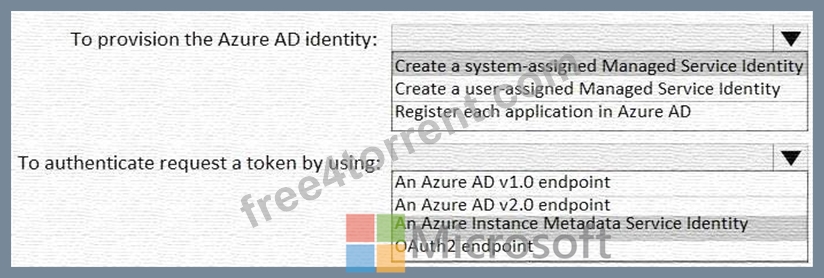
NEW QUESTION # 195
You have an Azure subscription that contains multiple storage accounts.
You assign Azure Policy definitions to the storage accounts.
You need to recommend a solution to meet the following requirements:
* Trigger on-demand Azure Policy compliance scans.
* Raise Azure Monitor non-compliance alerts by querying logs collected by Log Analytics.
What should you recommend for each requirement? To answer, select the appropriate options in the answer area. NOTE: Each correct selection is worth one point.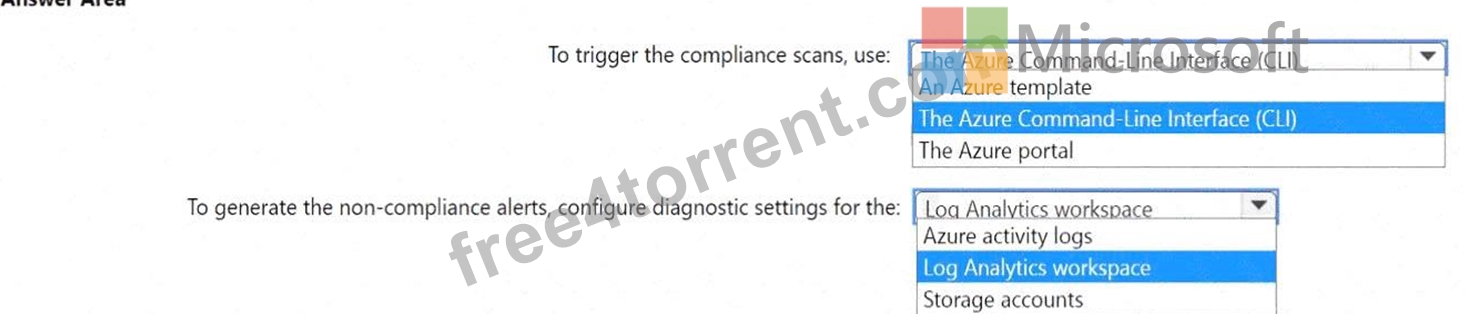
Answer:
Explanation: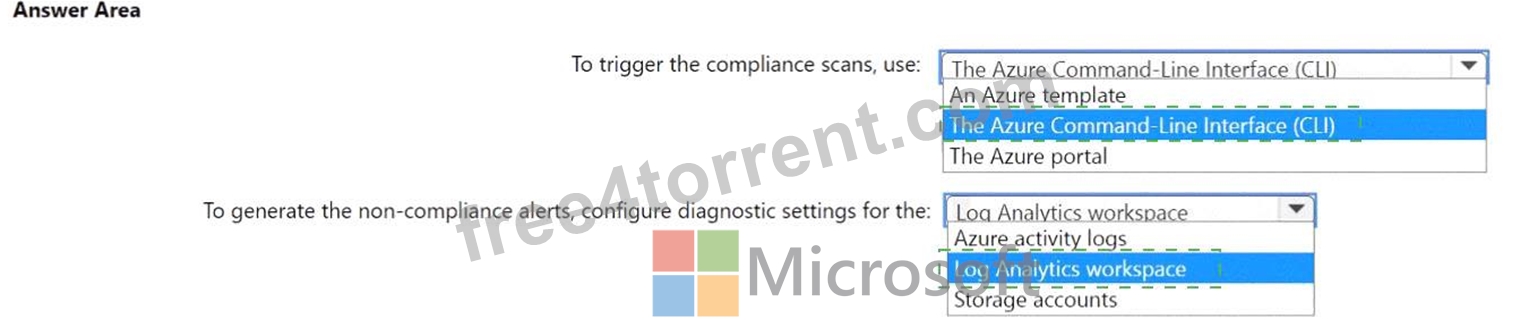
Explanation:
NEW QUESTION # 196
Case Study 3 - Contoso
Existing Environment: Technical Environment
The on-premises network contains a single Active Directory domain named contoso.com.
Contoso has a single Azure subscription.
Existing Environment: Business Partnerships
Contoso has a business partnership with Fabrikam, Inc. Fabrikam users access some Contoso applications over the internet by using Azure Active Directory (Azure AD) guest accounts.
Requirements: Planned Changes
Contoso plans to deploy two applications named App1 and App2 to Azure.
Requirements: App1
App1 will be a Python web app hosted in Azure App Service that requires a Linux runtime. Users from Contoso and Fabrikam will access App1.
App1 will access several services that require third-party credentials and access strings. The credentials and access strings are stored in Azure Key Vault.
App1 will have six instances: three in the East US Azure region and three in the West Europe Azure region.
App1 has the following data requirements:
* Each instance will write data to a data store in the same availability zone as the instance.
* Data written by any App1 instance must be visible to all App1 instances.
App1 will only be accessible from the internet. App1 has the following connection requirements:
* Connections to App1 must pass through a web application firewall (WAF).
* Connections to App1 must be active-active load balanced between instances.
* All connections to App1 from North America must be directed to the East US region. All other connections must be directed to the West Europe region.
Every hour, you will run a maintenance task by invoking a PowerShell script that copies files from all the App1 instances. The PowerShell script will run from a central location.
Requirements: App2
App2 will be a NET app hosted in App Service that requires a Windows runtime. App2 has the following file storage requirements:
* Save files to an Azure Storage account.
* Replicate files to an on-premises location.
* Ensure that on-premises clients can read the files over the LAN by using the SMB protocol.
You need to monitor App2 to analyze how long it takes to perform different transactions within the application. The solution must not require changes to the application code.
Application Development Requirements
Application developers will constantly develop new versions of App1 and App2. The development process must meet the following requirements:
* A staging instance of a new application version must be deployed to the application host before the new version is used in production.
* After testing the new version, the staging version of the application will replace the production version.
* The switch to the new application version from staging to production must occur without any downtime of the application.
Identity Requirements
Contoso identifies the following requirements for managing Fabrikam access to resources:
* Every month, an account manager at Fabrikam must review which Fabrikam users have access permissions to App1. Accounts that no longer need permissions must be removed as guests.
* The solution must minimize development effort.
Security Requirement
All secrets used by Azure services must be stored in Azure Key Vault.
Services that require credentials must have the credentials tied to the service instance. The credentials must NOT be shared between services.
Hotspot Question
You need to recommend a solution to ensure that App1 can access the third-party credentials and access strings. The solution must meet the security requirements.
What should you include in the recommendation? To answer, select the appropriate options in the answer area.
NOTE: Each correct selection is worth one point.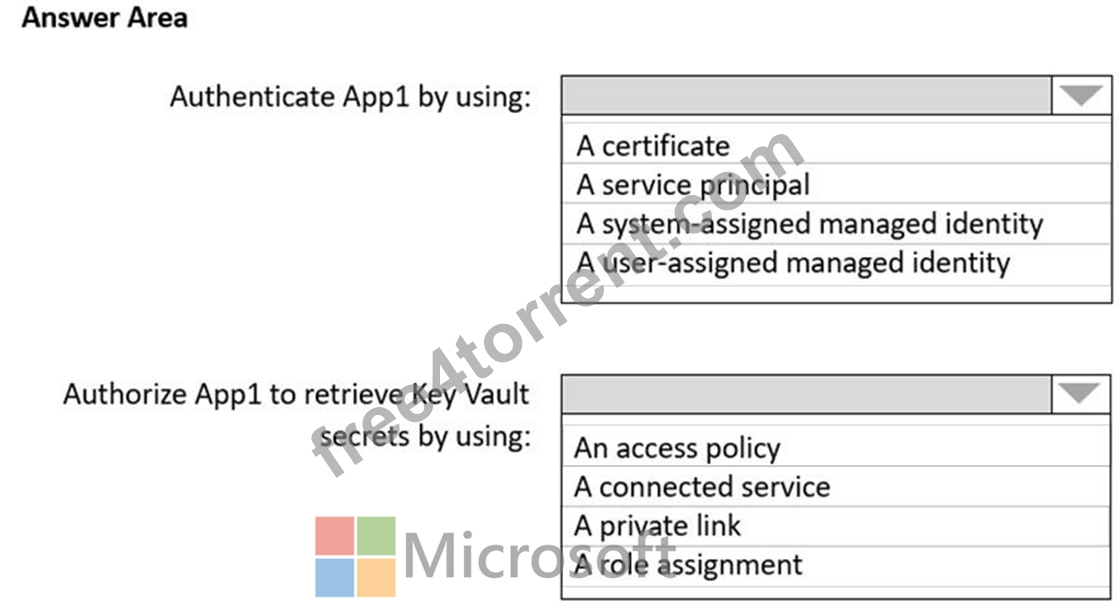
Answer:
Explanation: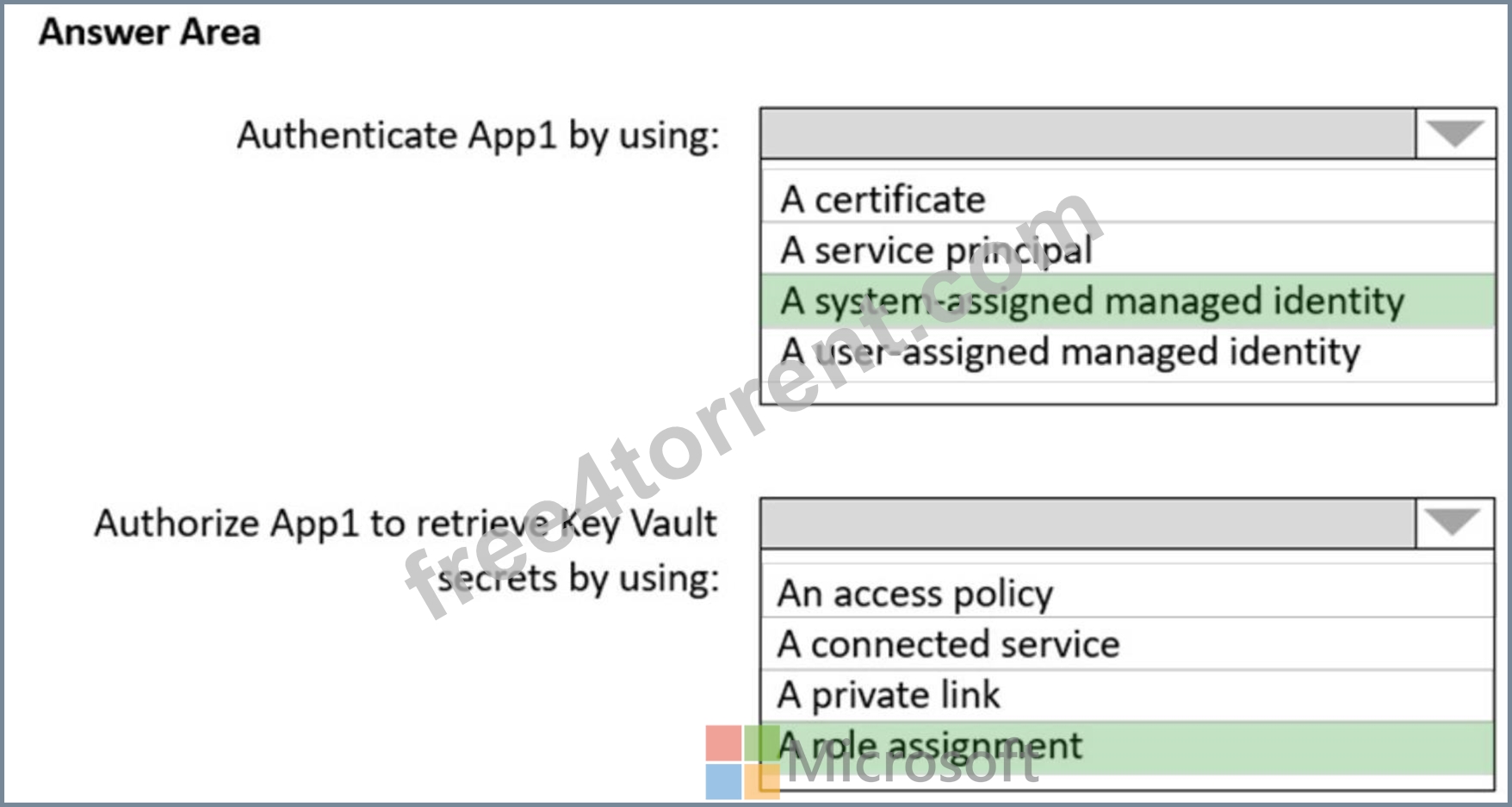
Explanation:
Box 1: A system-assigned managed identity
The credentials must NOT be shared between services. This is only fulfilled with a system assigned managed identity (where identity can only be assigned to one single resource). A user assigned managed identity can be assigned to multiple resources/services. For a regular Service Principal an admin must know credentials.
Box 2: A role assignment
When using the Access Policy permission model, if a user has Contributor permissions to a key vault management plane, the user can grant themselves access to the data plane by setting a Key Vault access policy. You should tightly control who has Contributor role access to your key vaults with the Access Policy permission model to ensure that only authorized persons can access and manage your key vaults, keys, secrets, and certificates. It is recommended to use the new Role Based Access Control (RBAC) permission model to avoid this issue. With the RBAC permission model, permission management is limited to 'Owner' and 'User Access Administrator' roles, which allows separation of duties between roles for security operations and general administrative operations.
Reference:
https://devblogs.microsoft.com/devops/demystifying-service-principals-managed-identities/
https://learn.microsoft.com/en-us/azure/key-vault/general/security-features?WT.mc_id=Portal- Microsoft_Azure_KeyVault#access-model-overview
NEW QUESTION # 197
......
100% Reliable Microsoft AZ-305 Exam Dumps Test Pdf Exam Material: https://realpdf.free4torrent.com/AZ-305-valid-dumps-torrent.html